
portobello mushroom Identification (Agaricus bisporus)

Recognize Agaricus bisporus by its smooth, rounded white to brown cap, a stout central stem, and free gills that do not attach to the stem. A partial veil leaves a distinct ring on the stem.

Caps are often 2 to 6 inches (5 to 15 cm) across, with a compact, symmetrical mushroom form.

Agaricus bisporus Identification

Check Your Plant ID

Take or upload a photo to confirm your plant ID with Botan.

Clear images work best. Avoid photos taken too close or too far away

Check the cap, gills, stem, and ring on Agaricus bisporus.

  • Cap is smooth, rounded to broadly convex, usually 2-6 inches (5-15 cm) across.
  • Gills are crowded and free from the stem, leaving a clear gap where they meet it.
  • Stem is stout, central, and usually 1-3 inches (2.5-7.5 cm) tall, with a single skirt-like ring.
  • Cap and stem are commonly white to brown, with no cup or sac at the stem base.

Use the ring, free gills, and lack of a basal cup as the quickest visible checks.

Agaricus bisporus shows clear visual shifts as the cap expands and the veil breaks.

  • Young plant: At first, the mushroom appears as a tight button with a rounded white to brown cap and a short, thick stem mostly hidden below it.
  • Mature plant: As it matures, the cap broadens to about 4-6 inches (10-15 cm), flattens, and the stem becomes more visible beneath the lifted margin.
  • Fruiting stage: When fruiting is fully developed, the partial veil tears away from the cap edge, exposing crowded gills that darken from pale pink to chocolate brown.

In Agaricus bisporus, the clearest visual forms are based on cap color and mature cap size.

  • white button: Typical form: a smooth white cap, usually harvested at about 1-2 inches (2.5-5 cm) wide while still closed.
  • cremini: Brown form with a tan to chestnut cap; usually sold at a similar immature stage but noticeably darker than white button.
  • portobello mushroom: The same brown form allowed to mature, with a broad open cap often 4-6 inches (10-15 cm) across and dark exposed gills underneath.

Several common mushrooms can be mistaken for portobello mushroom at a glance.

yellow stainer(Agaricus xanthodermus)

Similar cap shape and pink-to-brown gills can mislead. Check the stem base and cap edge: they bruise bright yellow, especially when rubbed, and the flesh often yellows quickly.

horse mushroom(Agaricus arvensis)

Also pale-capped with free gills that darken as it matures. It is usually larger, often with a thicker stem and a more substantial ring than Agaricus bisporus.

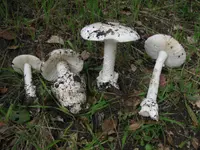
destroying angel(Amanita bisporigera)

Young buttons can look similarly white and rounded. The key difference is the gills stay white, not pink then brown, and the stem rises from a cup-like volva at the base.

Agaricus bisporus is widely naturalized, but its original native range is not securely established. For identification, habitat is more useful than geography. In the wild it typically appears in nutrient-rich, disturbed ground such as compost heaps, manure-rich soils, gardens, fields, and grassy margins rather than intact forest. Finding a similar Agaricus in these human-influenced places helps narrow the match, though habitat alone is not enough for confirmation.

  • Misidentification risk: Agaricus bisporus is edible, but confusing wild Agaricus mushrooms with toxic look-alikes can cause poisoning in humans and pets if eaten.
  • Key dangerous look-alike: Death cap, Amanita phalloides, is a serious ingestion hazard. A useful visible difference is spore color: Agaricus bisporus has dark brown gills and spores as it matures, while death cap has white gills and white spores.

Confirm It from a Photo

Botan can help identify or confirm it from a photo, which is useful when similar species make a visual check uncertain.

FAQ

Look for a smooth white to brown cap, crowded gills that turn from pink to chocolate brown, and a short stem with a ring. In portobello mushroom identification, mature caps are broad and often 4-6 inches (10-15 cm) wide.

More Plant Identification Guides

From Plant ID to Plant Info

Use Botan to identify it from a photo, then get species-specific plant details, care information, and common problems.

Botan app identifying a plant from a photo
Plants That Repel Mosquitoes – 10 Effective Choices

8 min read · 6 Jul 2026

Plants That Repel Mosquitoes – 10 Effective Choices

Plants that repel mosquitoes can help mask human scent naturally and make outdoor spaces more comfortable. Explore the most effective options, their benefits and drawbacks, and choose the right plant for your space.

Plant Recommendations

Plants That Repel Mosquitoes – 10 Effective Choices
How Fast Does Bamboo Grow Per Day, Month, and Year

10 min read · 7 Jul 2026

How Fast Does Bamboo Grow Per Day, Month, and Year

Bamboo grows extremely fast: some species can reach 5-6 m in just 3-4 months under the right conditions. This guide explains how much bamboo can grow per day, week, and year, and what affects its growth rate.

Plant Recommendations
How Fast Does Bamboo Grow Per Day, Month, and Year
Thorny Plants: A Comprehensive Guide

10 min read · 25 Aug 2026

Thorny Plants: A Comprehensive Guide

Many plants defend themselves with sharp thorns. This guide explores over 20 examples among flowers, shrubs, trees, and vines. You'll learn what each plant looks like, why it grows thorns, and how to quickly identify them.

Plant Recommendations
Thorny Plants: A Comprehensive Guide