Controlled substrate depth
Maintain a relatively shallow, even substrate layer (4–8 in) so the mycelium can fully colonize before fruiting, which helps reduce contamination pockets and supports more uniform flushes when growing Felt-ringed Agaricus.

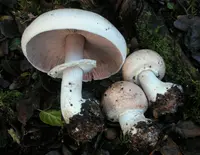
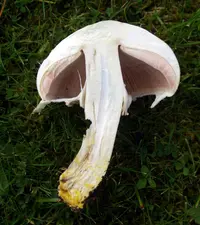
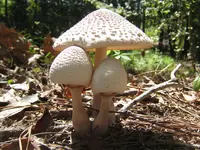
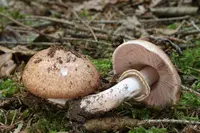
Felt-ringed Agaricus (Agaricus hondensis) is a wild gilled mushroom, not a typical houseplant or garden ornamental. It forms sturdy, pale to brownish caps with a dense, felt-like ring on the stem, which gives the species its common name. The gills start pale and darken as spores mature.
This fungus is native to western North America, where it grows on the ground in conifer and mixed forests, often in groups. It is not recommended for cultivation by beginners, as reliable identification and handling are more important than learning how to care for Felt-ringed Agaricus.
In nature it prefers cool, moist forest soils rich in organic matter and often appears during wetter seasons.

Care Difficulty
Hard Care

Light Preference
Partial Shade

Water Requirements
Keep Soil Moist

Temperature Preference
Cool Climate

Hardiness Zone
Unknown

Soil Texture
Loamy, Silty, Organic-rich

Soil pH
Acidic (5.5–6.5)

Soil Drainage
Moist but well-drained

Fertilization
Minimal (feed rarely)
Scan your plant to receive care tips personalized for your specific plant
Available on iOS and Android
This woodland mushroom prefers cool, shaded conditions similar to conifer forest floors.
This fungus relies on consistently moist, well-drained forest-type soil rather than frequent surface watering.
This species fruits best in cool to mild conditions typical of coastal and montane conifer forests.
This mushroom species needs consistently moist, cool air around the fruiting area to form healthy caps.
Agaricus hondensis requires a moist, organic-rich substrate rather than typical garden soil.
This species is difficult but possible to grow in containers when conditions are tightly controlled.
This wild fungus is usually not fertilized directly, since Agaricus hondensis relies on natural forest soil nutrients.
Pruning is not applicable to Agaricus hondensis, which is a wild mushroom rather than a woody or leafy plant.
This species is rarely grown in containers; in cultivation, focus on placing substrates correctly rather than repotting.
In practice, Agaricus hondensis is not commonly propagated intentionally, as it is a wild, mycorrhizal-associated mushroom with complex ecological needs.
No special winter care is usually provided, since this wild fungus persists naturally in suitable climates without targeted protection.

Plant Health Check
Not sure what's wrong with your plant? Check your plant's health inside the app.
Fresh fruiting bodies often smell strongly of phenol or ink, especially when cut or bruised, which helps distinguish it from edible look-alike Agaricus species that usually smell pleasant or anise-like.
The cap and stem surfaces usually stain yellow when handled or scratched, particularly near the base, a chemical reaction that, together with the phenolic odor, is a key field character for Agaricus hondensis care instructions.
This species is typically found in mixed and conifer forests of western North America, often associated with Douglas-fir and other conifers, fruiting on the ground in soil rich in decomposing organic matter.

Agaricus hondensis has been repeatedly implicated in poisoning cases when mistaken for edible field or meadow Agaricus species, and consumption can cause significant gastrointestinal distress, so mycologists stress careful identification and avoidance of this taxon as food.
This species contains dangerous toxins that can cause severe gastrointestinal and neurological symptoms in both humans and pets. It must never be eaten. Teach children not to touch or taste wild mushrooms and remove fruiting bodies from yards.
Keep your plants happy and healthy with plant identification, disease detection, and easy care guidance.