


Sterilize Growing Medium
Before inoculation, pasteurize or sterilize manure or straw substrate at 60–70°C for at least 1 hour to reduce competing fungi and bacteria and give the mycelium a clear advantage.

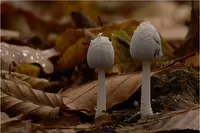
Coprinopsis nivea, commonly called snowy inkcap, is a small saprophytic fungus that feeds on decaying organic matter, often dung or rich pasture soil. It is not a typical houseplant but sometimes appears spontaneously in gardens, lawns, or compost-rich areas.
The caps are white, finely hairy when young, and quickly turn gray and inky as they mature and dissolve. Fruiting bodies are short-lived and can appear in clusters after rain.
This species prefers moist, nutrient-rich substrates and cool to mild conditions. Because it is a specialized decomposer with a brief life cycle, it is not practical to cultivate intentionally, and attempts to care for Snowy Inkcap at home are usually unreliable.

Care Difficulty
Hard Care

Light Preference
Partial Shade

Water Requirements
Keep Soil Moist

Temperature Preference
Cool Climate

Hardiness Zone
Unknown

Soil Texture
Loamy, Silty, Organic-rich

Soil pH
Acidic (5.5–6.5), Slightly acidic (6.5–7.0)

Soil Drainage
Moist but well-drained

Fertilization
Minimal (feed rarely)
Scan your plant to receive care tips personalized for your specific plant
Available on iOS and Android
This saprophytic fungus prefers cool, softly lit sites rather than direct, intense sun.
This species needs consistently moist, organic substrates rather than a defined watering schedule.
This fungus fruits best in cool to mild conditions with moderate temperature swings.
This fungus prefers consistently moist, humid conditions to fruit well.
Coprinopsis nivea fruits best on very moist, loose, organic-rich substrates rather than typical garden soil.
This species can be grown in shallow containers if the substrate and moisture are managed carefully.
Coprinopsis nivea is a saprophytic fungus that usually does not need direct fertilization when grown on suitably rich organic substrates.
Coprinopsis nivea does not require conventional pruning because its fruiting bodies are short-lived and decompose naturally after spore release.
This fungus is not managed like a potted plant; instead, it is established on suitable organic material rather than repotted.
Reproduction of Coprinopsis nivea is mainly handled by spore dispersal and substrate inoculation rather than traditional horticultural propagation.
Snowy Inkcap needs no dedicated winter care in typical outdoor settings, as the fungus persists unseen in organic matter and fruits during suitable conditions.

Plant Health Check
Not sure what's wrong with your plant? Check your plant's health inside the app.
This fungus is strongly associated with herbivore dung, especially horse manure, where it decomposes nutrient-rich organic matter and helps recycle nitrogen and other minerals back into the soil.
The cap is densely covered with fine white granules derived from the universal veil, giving it a frosted or snowy appearance that contrasts with the darker gills below as it matures.
Like other inkcaps, it undergoes autodigestion, where the gills and cap tissue liquefy into a black, inky fluid as spores are released, a process that rapidly changes its appearance within hours.

Coprinopsis nivea is considered an indicator of relatively undisturbed, nutrient-rich grassland systems with ongoing grazing, so its presence can signal both active herbivore use and a healthy decomposer community in pasture habitats.
This fungus develops very quickly. Tiny pins can appear within a day after rain and often reach full size in 1–2 days, then liquefy and collapse soon after. Growth is rapid but very short-lived.
Keep your plants happy and healthy with plant identification, disease detection, and easy care guidance.

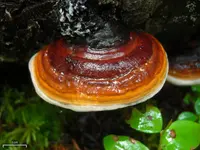
Red-banded polypores
Fomitopsis pinicola
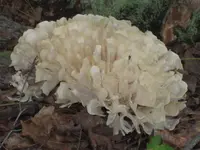
Eastern cauliflower mushroom
Sparassis spathulata
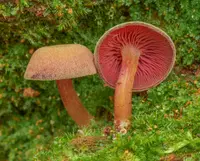
Purple-edged Lute
Callistosporium purpureomarginatum
King Trumpet Mushroom
Pleurotus eryngii
Wine-colored Agaricus
Agaricus subrutilescens
Cauliflower Fungus
Sparassis crispa
California Agaricus
Agaricus californicus
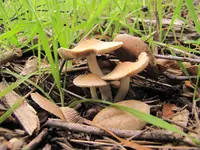
Coprinopsis uliginicola
Coprinopsis uliginicola