


Log selection
Choose freshly cut, unsprayed conifer logs with intact bark and at least 10–15 cm diameter, as older or heavily decayed wood often has competing fungi that outgrow Fomitopsis pinicola.

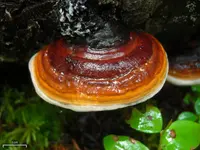
Red-banded polypores, Fomitopsis pinicola, are perennial bracket fungi that grow on dead or weakened conifer and sometimes hardwood trees. They are not true plants but are often grouped with plants in care collections.
The fruiting bodies form hard, shelf-like structures with a glossy, resinous surface and distinct red, orange, and white bands near the outer edge. They can persist on the same log or trunk for many years.
In nature, this species occurs widely across temperate forests in North America, Europe, and parts of Asia, where it helps decompose wood. It is tough, slow-changing, and does not need typical pot care, so how to care for Red-banded polypores mainly concerns providing stable wood, shade, and moderate moisture.

Care Difficulty
Moderate Care

Light Preference
Shade

Water Requirements
Keep Soil Moist

Temperature Preference
Cold Hardy

Hardiness Zone
3–8

Soil Texture
Organic-rich, Loamy

Soil pH
Strongly acidic (4.5–5.5), Acidic (5.5–6.5)

Soil Drainage
Moist but well-drained

Fertilization
Minimal (feed rarely)
Scan your plant to receive care tips personalized for your specific plant
Available on iOS and Android
This wood-decay fungus thrives on shaded to partially lit tree trunks rather than in direct, open sun.
This bracket fungus relies on moisture in the host wood and surrounding environment rather than direct, frequent watering.
This species is cold hardy and tolerates a wide range of outdoor temperatures typical of temperate forests.
This wood-decay fungus is not suitable for typical home cultivation, and air humidity is rarely the limiting factor compared with host wood moisture.
This species naturally colonizes dead or dying conifers and does not grow in conventional soil, so culture focuses on preparing the woody substrate.
This bracket fungus is generally unsuitable for standard container growing, as it requires solid woody hosts rather than potting media.
This wood-decay fungus grows on nutrient-rich trees and typically does not need additional fertilizer in cultivation.
Pruning is not a standard practice for Fomitopsis pinicola, which naturally forms hard, persistent conks on wood.
When grown on logs or stumps, this fungus is managed by relocating or replacing its woody substrate rather than traditional repotting.
Propagation of Fomitopsis pinicola is usually done by spore inoculation or transferring colonized wood rather than home-style cuttings.
This species is very cold hardy and normally requires no special winter care outdoors.

Plant Health Check
Not sure what's wrong with your plant? Check your plant's health inside the app.
This species can cause both brown rot in softwoods and a white-pocket rot in some hardwoods, an unusual versatility among wood-decay fungi that allows it to exploit a wide range of hosts.
It often colonizes resin-rich conifers such as spruce, pine, and fir, and fruiting bodies are frequently seen emerging near knots and resin pockets where the fungus first gained entry.
The bright red to orange band at the growing margin of the bracket is most vivid when the fungus is actively expanding, and it often fades to brown or black as that portion of the fruiting body ages and becomes inactive.

Individual bracket fruiting bodies of this species can persist for many years, adding new tubes in layers annually, so large shelves on old conifer trunks may represent a long history of repeated spore production from the same fungal individual.
The fruiting body is technically edible but very tough, woody, and not suitable as regular food. It has been used traditionally in folk remedies, but ingestion is not recommended without expert guidance and reliable identification.
Keep your plants happy and healthy with plant identification, disease detection, and easy care guidance.

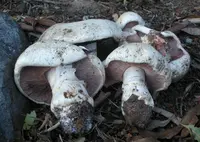
Salt-loving Agaricus
Agaricus bernardi
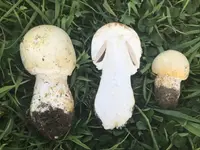
Agaricus crocodilinus
Agaricus crocodilinus
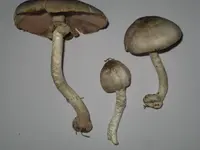
inky mushroom
Agaricus placomyces
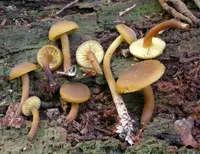
Olive Lute
Callistosporium luteo-olivaceum
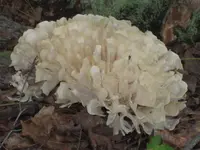
Eastern cauliflower mushroom
Sparassis spathulata
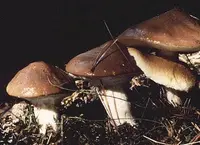
Slippery Jack
Suillus luteus
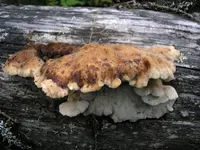
Amylocystis lapponica
Amylocystis lapponica
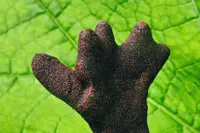
dead man's fingers
Xylaria polymorpha