Safe plant placement
Site the plant well away from walkways, driveways, and play areas so the stiff, sharp leaf tips cannot injure people or pets; in small spaces, install a low barrier or decorative stones to discourage brushing past it.

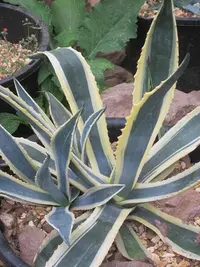
Variegated century plant (Agave americana 'Marginata') is a bold, architectural succulent valued for its striking striped leaves and strong desert look. It forms a large rosette of stiff, sword-shaped foliage with yellow or cream margins and sharp spines along the edges.
This agave species is native to arid regions of Mexico but is widely grown in warm, dry climates and as a container specimen in cooler areas. It grows slowly and eventually can send up a very tall flowering stalk once near the end of its life cycle.
Thick, water-storing leaves and a strong drought tolerance make it relatively low-maintenance if given sharp drainage and plenty of light. Understanding how to care for Variegated Century Plant mainly involves managing sun exposure, cold sensitivity, and its eventual large size.

Care Difficulty
Easy Care

Light Preference
Full Sun

Water Requirements
Low Water

Temperature Preference
Warm Climate

Hardiness Zone
8–11

Soil Texture
Sandy, Loamy, Rocky

Soil pH
Slightly acidic (6.5–7.0), Slightly alkaline (7.0–7.5)

Soil Drainage
Well-drained

Fertilization
Minimal (feed rarely)
Scan your plant to receive care tips personalized for your specific plant
Available on iOS and Android
This succulent thrives in strong light and handles direct sun once established.
This agave is highly drought-tolerant and prefers infrequent, deep watering.
This species prefers warm, dry climates and tolerates considerable heat once established.
This species prefers dry air and does not need added humidity indoors or outdoors.
Agave americana 'Marginata' requires very fast-draining, mineral-based soil to prevent root rot.
This species is suitable for container growing, especially where winters are cold or soil drains poorly.
This drought-adapted succulent needs only light feeding for healthy growth and strong leaf color.
Pruning Agave americana 'Marginata' focuses on safety, cleanliness, and preventing rot rather than shaping.
Container-grown plants and young outdoor specimens benefit from careful transplanting to support steady growth.
This agave is most commonly propagated from offsets rather than seed for predictable variegation.
Cold sensitivity means winter care is important in regions with freezing temperatures.

Plant Health Check
Not sure what's wrong with your plant? Check your plant's health inside the app.
The cream-yellow margins on the leaves come from a stable genetic mutation, so this variegated pattern stays consistent through offsets instead of reverting to solid green like some other variegated succulents.
The pale leaf margins have less chlorophyll than the green center, which makes this plant more prone to sun scorch than plain Agave americana and explains why it often shows better color in bright but not extreme full sun.
Compared with the typical blue-green century plant, this cultivar usually forms a somewhat smaller rosette, a trait that makes Agave americana 'Marginata' plant care more manageable in gardens and large containers.

This plant still follows the classic agave life cycle: it grows for many years, then sends up a single tall flowering stalk and dies afterward, but the offsets it produces around the base allow the clump to persist in the same spot for decades.
Brown tips or edges usually come from underwatering, intense reflected heat, or salt buildup from fertilizer. Check soil moisture, flush the soil occasionally, and shield from hot reflected surfaces like concrete or metal to reduce stress.
Keep your plants happy and healthy with plant identification, disease detection, and easy care guidance.