Stabilize Tall Stems
As the plant gains height, anchor the main trunk to a sturdy stake or heavy pot rock to prevent wind snap or tipping, especially in containers exposed to outdoor breezes.

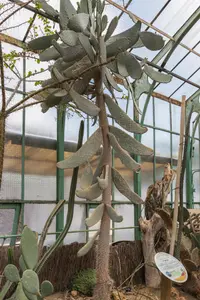
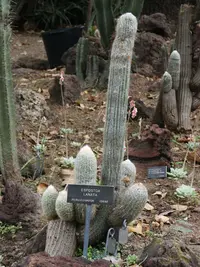
Consolea moniliformis, commonly called tuna or necklace cactus, is a tree-forming prickly pear relative with jointed, beaded stems and sparse pads. It develops a sculptural, upright shape that can resemble a small, leafless tree over time.
This species is native to the Caribbean, especially Puerto Rico and nearby islands, where it grows in hot, dry, coastal habitats. Its drought tolerance and slow, steady growth make it relatively easy to keep alive, but the spines require careful handling.
It generally prefers strong light, very fast-draining mineral soil, and infrequent watering, which guides how to care for tuna in home or greenhouse settings.

Care Difficulty
Easy Care

Light Preference
Full Sun

Water Requirements
Low Water

Temperature Preference
Tropical / Frost Sensitive

Hardiness Zone
10–12

Soil Texture
Sandy, Loamy, Rocky

Soil pH
Slightly acidic (6.5–7.0), Neutral (7.0)

Soil Drainage
Well-drained

Fertilization
Minimal (feed rarely)
Scan your plant to receive care tips personalized for your specific plant
Available on iOS and Android
Consolea moniliformis thrives in strong, direct light that mimics its native Caribbean habitat.
This cactus prefers thorough but infrequent watering that allows the root zone to dry between soakings.
This species prefers warm, arid conditions and is sensitive to prolonged cold or frost.
This cactus-like species handles low household humidity well, so moisture in the air is rarely a limiting factor.
Consolea moniliformis prefers a very fast-draining, mineral-rich, gritty substrate that mimics arid, rocky habitats.
This species is well suited to container culture, especially where winter protection or controlled drainage is needed.
Consolea moniliformis grows acceptably in lean soils but benefits from modest feeding in containers or poor ground.
Consolea moniliformis needs only light, purposeful pruning to manage size and remove damaged pads or stems.
This species tolerates long periods in the same spot, so repotting or transplanting is infrequent but should be done carefully.
Consolea moniliformis is most commonly propagated from stem or pad cuttings, with seed used mainly by specialists.
Consolea moniliformis is frost sensitive and needs protection in climates with freezing winters, especially in containers.

Plant Health Check
Not sure what's wrong with your plant? Check your plant's health inside the app.
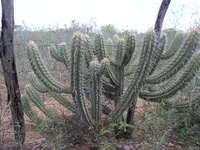
This species develops elongated, tree-like stems with rounded, bead-like segments arranged along the pads, giving it a moniliform or necklace-like appearance that is unusual among Caribbean opuntioid cacti.
It commonly forms dense thickets on dry coastal scrub and limestone outcrops in the Greater Antilles, where its tolerance of salt spray and high light helps stabilize fragile shoreline habitats.
Its small, short-lived leaves appear only briefly on new growth and quickly fall off, with the flattened pads and stems taking over photosynthesis and water storage, a typical opuntioid adaptation expressed strongly in this species.

In its native range, this cactus can develop a single upright trunk with a rounded canopy and reach small-tree size, sometimes over several meters tall, making it one of the more arborescent opuntioid cacti in Caribbean dry forests.
Growth is slow to moderate. Young plants may add 5–15 cm per year, then speed up in warm climates. Over many years it can form a tree-like structure 2–6 m tall, sometimes taller outdoors.
Keep your plants happy and healthy with plant identification, disease detection, and easy care guidance.