rough century plant Care (Agave asperrima)

rough century plant

About rough century plant

The rough century plant, Agave asperrima, is a hardy succulent native to arid regions of northern Mexico and the southern United States. It forms a striking rosette of thick, blue-green leaves with a coarse texture, sharp teeth, and a strong terminal spine.

This species grows slowly and can become large over time, suiting it to spacious outdoor xeriscapes rather than small containers. It prefers full sun, very well-drained soil, and minimal watering, which simplifies basic care for rough century plant in dry climates.

Its tough leaves and drought tolerance make it resilient, but the spines demand careful placement away from walkways and play areas.

Main Plant Requirements

Care Difficulty

Easy Care

Light Preference

Full Sun

Water Requirements

Low Water

Temperature Preference

Warm Climate

Hardiness Zone

8–11

Soil Texture

Sandy, Loamy, Rocky

Soil pH

Slightly acidic (6.5–7.0), Slightly alkaline (7.0–7.5)

Soil Drainage

Well-drained

Fertilization

Minimal (feed rarely)

Get Personalized Care Plan

Scan your plant to receive care tips personalized for your specific plant

Available on iOS and Android

How to Care for the rough century plant

This desert species needs intense light to keep its compact shape and strong leaf color.

  • Provide 6–10 hours of direct sun daily; in hot inland areas, give full morning sun with light afternoon shade to prevent scorch on young plants.
  • Mature rough century plant tolerates all-day sun, but new or recently moved plants benefit from 2–4 weeks of filtered light while acclimating.
  • In regions with weak winter sun, choose the brightest south- or west-facing exposure to avoid stretched, pale growth.

This agave is very drought-tolerant and needs infrequent, deep watering once established.

  • Outdoors in arid or semi-arid climates, water only when the top 5–8 cm of soil are completely dry and leaves just begin to look slightly less rigid.
  • Ensure sharply draining, gravelly soil so excess water moves away quickly; standing water or heavy clay promotes root and crown rot in Agave asperrima.
  • In cooler months, reduce watering sharply and skip if rain is forecast; yellowing, soft leaves suggest overwatering, while severe wrinkling indicates prolonged drought.

This species prefers hot, dry conditions but handles a fairly wide temperature range when soils drain well.

  • Ideal growing temperatures are about 70–95°F (21–35°C), typical of warm desert or summer conditions with low humidity.
  • Mature plants can survive brief drops to around 15–20°F (-9 to -6°C) if dry, but repeated hard freezes or wet cold greatly increase tissue damage risk.
  • In extreme heat above 105°F (41°C), good airflow and avoiding reflected heat from walls or rock mulch around the crown help limit leaf burn.

Humidity is rarely a concern for this desert species kept indoors or outdoors.

This species needs very fast-draining, mineral-based soil to prevent root and crown rot.

  • Use a gritty cactus mix made from roughly 50–70% inorganic materials such as coarse sand, pumice, or small gravel, with minimal organic matter.
  • Maintain a loose, open structure that allows water to pass through within seconds and leaves air spaces around the roots.
  • Aim for slightly acidic to neutral pH, around 6.0–7.2, avoiding very acidic or strongly alkaline substrates.
  • Avoid dense, peat-heavy, or clay-rich mixes that stay wet for more than a few hours, as Agave asperrima is highly sensitive to soggy conditions.

This species is suitable for container growing where winters are wet or cold.

  • Choose a wide, heavy container to stabilize the tall, spiny rosette and prevent tipping in strong wind.
  • Use a pot material like unglazed terracotta to allow faster evaporation and reduce the risk of prolonged wetness around roots.
  • Raise the pot on feet or blocks so drainage holes stay clear and runoff water moves away quickly after irrigation or rainfall.

This drought-adapted succulent needs only light feeding to maintain steady growth in containers or poor soils.

  • In spring and early summer, use a balanced NPK succulent or cactus fertilizer at 1/2–1/4 strength.
  • Feed potted rough century plant once per month during the active growing season only.
  • Avoid fertilizing in fall and winter when growth slows or stops.
  • Skip compost-rich mixes; use lean, gritty soil to prevent soft, weak growth.

Agave asperrima needs minimal pruning, mainly for safety and cleanliness rather than shaping.

  • Best time is late spring or early summer, during active growth and dry weather.
  • Remove only dead, damaged, or pest-infested leaves using long-handled, sharp pruners or a pruning saw.
  • Trim spent flower stalks at the base once they dry out, as the flowering rosette will not reflower.
  • Avoid cutting healthy leaves; heavy removal can stress the plant and distort its natural form.

This agave is usually grown in-ground, with transplanting done rarely and only when necessary.

  • Transplant in late spring or early summer once soil is warm and frost risk has passed.
  • Look for roots circling the pot, cracking containers, or very slow growth as cues to move the plant.
  • Plan on moving container-grown plants only every 3–5 years into a slightly larger, very fast-draining pot.
  • Minimize root stress by keeping the root ball intact, handling with thick gloves, and watering lightly after planting.

Agave asperrima is most often propagated vegetatively through offsets rather than by seed for home growers.

  • Detach offsets in late spring or early summer when they are 10–15 cm across and well rooted.
  • Use a clean, sharp knife, dust cut surfaces with sulfur or cinnamon, and let them callus for 3–5 days.
  • Plant in a gritty, barely moist cactus mix and keep in bright, indirect light until established.
  • Seed propagation is possible but slower; provide warm temperatures around 70–80°F and evenly moist, not wet, substrate.

This species is relatively cold hardy when established but still benefits from thoughtful winter management in cold regions.

  • Mature plants often tolerate brief drops to about 10–15°F if soil is very well drained.
  • In marginal climates, apply a 5–8 cm gravel mulch to improve drainage around the crown and roots.
  • Keep foliage dry by siting plants on slopes or raised beds; avoid standing water or heavy snow loads.
  • Move container plants to an unheated, bright, frost-free area and water sparingly to prevent rot.

Care Tips

Safe handling setup

Install the plant in a spot where people and pets do not brush past it, and use thick gloves and long sleeves whenever you repot or shift the container to avoid injury from the stiff, hooked spines.

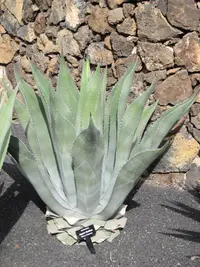
Rock mulch barrier

Top-dress the soil with a 2–4 cm layer of coarse gravel or small rocks to stabilize the plant, keep the crown drier, and discourage rot while still allowing excellent drainage.

Root inspection schedule

Every 2–3 years, unpot and check the root system at the start of warm weather, trimming only dead, black, or mushy roots and replanting slightly higher if the stem base has sunk below the soil line.

Winter rain protection

In regions with wet winters, position the container under an overhang or use a simple clear cover that blocks overhead rain but remains open at the sides so the plant stays dry while air circulation remains high.

Controlled offset removal

When offsets are at least 5–8 cm across and have their own visible roots, cut them off cleanly with a disinfected knife, let the cut dry for 3–5 days, then pot them in a very gritty mix to expand your collection while easing crowding when caring for rough century plant.

Common Pests and Diseases

Agave snout weevil

This pest bores into the base of the rosette, causing internal tunneling and collapse of the plant, often with a fermented or rotten smell. Symptoms include wilting, yellowing, and the whole agave folding over from the crown.

Solution

Remove and destroy any infested plant, including as much of the root system as possible, to reduce the local weevil population. For nearby Agave asperrima, inspect crowns regularly, avoid fresh wounds during peak weevil activity, and consider using a systemic insecticide drench labeled for agaves in early spring in areas where this pest is established.

Agave mite

These insects are microscopic eriophyid mites that hide in the leaf bases and tight crevices, causing distorted new growth, rough or corky patches, and mottled or streaked leaves. Symptoms include stunted, twisted rosettes and sometimes dark, crusty tissue at the leaf bases.

Solution

Discard heavily infested plants, as mites are difficult to eliminate once established and can spread to other agaves. For mild or early cases, isolate the plant, remove and trash the most distorted leaves, then treat the crown and leaf bases with an appropriate miticide spray, repeating as directed while maintaining good spacing and airflow between plants.

Soft scale

These insects attach to leaves as small, flattened bumps and suck plant sap, leading to pale, stressed foliage and sticky honeydew on the leaf surfaces. Symptoms include sooty mold growth on the honeydew and reduced vigor over time.

Solution

Physically remove scale with a cotton pad dipped in diluted isopropyl alcohol, or gently scrub leaves with a soft brush and mild soapy water, then rinse well. For larger infestations, apply a horticultural oil or insecticidal soap labeled for succulents, ensuring good coverage of leaf surfaces and repeating applications as needed.

Leaf spot

This disease usually appears as small, dark, water-soaked or tan lesions on the leaves, sometimes with a yellow halo, which can merge into larger irregular patches under prolonged moisture. Symptoms include cosmetic damage that can slowly expand, especially in humid or poorly ventilated conditions.

Solution

Remove and discard affected leaves if practical, and avoid overhead watering so foliage dries quickly. Improve spacing and airflow around the plant, and if spots continue to spread, apply a copper-based or other labeled fungicide to new and existing leaves, following label directions and allowing the plant to dry between treatments.

Crown and heart rot

This disease causes the central growth point to soften and turn brown or black, often with a foul odor and collapse of the inner leaves, especially after prolonged wet or cool conditions. Symptoms include a mushy crown and leaves pulling away easily from the base.

Solution

At early stages, cut out all soft, discolored tissue from the crown with a sterile knife and allow the plant to dry in a very well-ventilated, warm place, keeping water off the wound. If rot is extensive, discard the plant to protect nearby agaves, and in the future plant A. asperrima in fast-draining soil, on a slope or raised mound, and avoid water collecting in the rosette during cool seasons.

Interesting Facts

Extreme desert hardness

This species naturally occurs on exposed limestone slopes and gravelly desert plains in northern Mexico and south Texas, tolerating intense sun, high heat, and very low rainfall that would kill many other agaves.

Distinctively rough leaves

The thick, gray-green leaves have a noticeably rough, sandpapery surface caused by dense microscopic structures on the cuticle, an adaptation that reduces water loss and diffuses intense light.

Heavy defensive armature

Its broad leaves carry a strong terminal spine and stout marginal teeth that can curve slightly outward, a physical defense that deters large herbivores in its open, sparsely vegetated habitat.

Botan icon

Did you know?

In its native range, this species often forms long-lived, solitary rosettes that may take several decades to flower once, producing a very tall, branched inflorescence and then dying after seed set, a life history strategy known as semelparity.

FAQs about rough century plant

Growth is slow. Young rosettes usually add only a few leaves per year and increase in diameter gradually. In suitable dry, sunny conditions it may take 10–20 years to approach full size.

Grow Healthy Plants with Botan Care

Keep your plants happy and healthy with plant identification, disease detection, and easy care guidance.

Botan plant care app — identify plants on mobile

Explore More Plants