Promote strong offsetting
Leave a 2–3 cm ring of bare, grit-mulched soil around the rosette base so pups can emerge cleanly and be removed with minimal root damage when dividing for propagation.

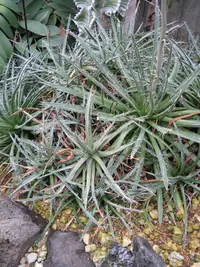
The smallflower century plant, Agave parviflora, is a compact succulent native to arid regions of Arizona and northern Mexico. It forms tight rosettes of narrow, dark green leaves with fine white fibers and pale striping.
This species stays relatively small compared to many agaves, which makes it suitable for containers and rock gardens. Its slow growth and drought tolerance generally make it low-maintenance.
Sharp leaf tips and sensitivity to overwatering are the main traits that can challenge beginners. In general, it prefers bright light, very well-drained soil, and infrequent watering, which guides how to care for smallflower century plant.

Care Difficulty
Easy Care

Light Preference
Full Sun

Water Requirements
Low Water

Temperature Preference
Warm Climate

Hardiness Zone
8–10

Soil Texture
Sandy, Loamy, Rocky

Soil pH
Slightly acidic (6.5–7.0), Neutral (7.0)

Soil Drainage
Well-drained

Fertilization
Minimal (feed rarely)
Scan your plant to receive care tips personalized for your specific plant
Available on iOS and Android
This desert succulent thrives in bright, direct light and is best suited to full-sun outdoor conditions.
This species prefers infrequent, deep watering that allows the soil to dry thoroughly between soakings.
This compact agave is adapted to hot, arid climates but has moderate cold tolerance when kept dry.
Agave parviflora handles low humidity well and rarely needs special adjustment indoors.
Agave parviflora prefers a very fast-draining, mineral, slightly alkaline to neutral substrate.
This species is well suited to container growing due to its compact rosette and slow root expansion.
Agave parviflora needs only light feeding, especially in containers, to support steady growth without forcing lush, weak tissue.
Pruning for Agave parviflora is minimal and focuses on hygiene rather than shaping.
Container-grown Agave parviflora grows slowly and needs infrequent repotting or transplanting.
Agave parviflora is mainly propagated by separating offsets, with seed used less often in home settings.
Mature Agave parviflora is fairly cold hardy but still benefits from simple winter precautions in colder regions.

Plant Health Check
Not sure what's wrong with your plant? Check your plant's health inside the app.
This species forms very small, tight rosettes only about 10–20 cm across, making it one of the most compact agaves adapted to arid grasslands and rocky slopes in southern Arizona and northern Sonora.
Its narrow dark green leaves have persistent white marginal fibers and delicate white leaf markings, a combination that creates a striking, almost hand-painted appearance unique enough to differentiate it from nearby agave species in the wild.
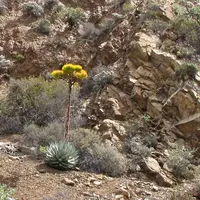
The plant grows slowly for many years, then sends up a tall flowering stalk once in its lifetime, after which the rosette dies, a life cycle pattern known as being monocarpic.

Agave parviflora is considered one of the smallest agave species in its native range, and its limited natural distribution has led to conservation concern, resulting in protection in parts of Arizona to prevent over-collection from wild populations.
This species blooms only once, usually after many years, then the main rosette slowly dies. It often produces offsets around the base before or after flowering, which can be kept to continue the planting.
Keep your plants happy and healthy with plant identification, disease detection, and easy care guidance.