Safe handling setup
Place the plant where its spines cannot snag walkways or pets, and always use thick gloves and long sleeves when repotting or repositioning to avoid both injury and contact with the irritating latex sap.

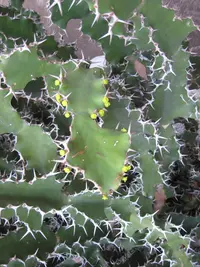
Euphorbia grandicornis, often called Grandthorn Noors, is a sculptural succulent shrub with tall, three-angled green stems and prominent paired spines along the ridges. It branches irregularly, forming a dense, upright clump that resembles a cactus, though it belongs to the spurge family.
This species is native to dry regions of southern Africa, where it grows in rocky, well-drained habitats. It is adapted to strong light and long dry periods, which makes it relatively low-maintenance indoors when watering is controlled.
Its main challenges are sensitivity to overwatering and the irritating milky sap released when stems are damaged. Those who care for Grandthorn Noors should provide bright light, a gritty soil mix, and careful handling.

Care Difficulty
Moderate Care

Light Preference
Full Sun

Water Requirements
Low Water

Temperature Preference
Tropical / Frost Sensitive

Hardiness Zone
10–11

Soil Texture
Sandy, Loamy, Rocky

Soil pH
Slightly acidic (6.5–7.0), Neutral (7.0)

Soil Drainage
Well-drained

Fertilization
Minimal (feed rarely)
Scan your plant to receive care tips personalized for your specific plant
Available on iOS and Android
This succulent prefers bright, direct light but benefits from some protection during the hottest hours.
This drought-tolerant succulent stores water in its stems and is sensitive to excess moisture.
This species prefers warm, dry conditions and is not tolerant of frost.
This succulent tolerates dry indoor air and rarely needs special humidity control.
This species needs a sharply draining, mineral-rich mix to prevent root and stem rot.
This species grows reliably in containers when the pot supports its heavy, spiny stems.
This drought-tolerant succulent needs modest feeding to support healthy, controlled growth.
Pruning Euphorbia grandicornis is mainly done to control size, remove damage, and maintain a safe, tidy form.
This succulent prefers to stay slightly root-bound and only needs infrequent repotting or transplanting.
Propagation of Euphorbia grandicornis is usually done from stem cuttings rather than seeds.
This species is frost-sensitive and needs protection from freezing winter conditions, especially in containers.

Plant Health Check
Not sure what's wrong with your plant? Check your plant's health inside the app.
This species develops thick, 3-angled stems with sharply projecting, horn-like wings that give rise to the name grandicornis, meaning large-horned. The paired spines sit along these winged ridges and help shade the stem surface in intense sun.
When cut or damaged, it exudes a white latex sap that is irritating to skin and eyes and can be poisonous if ingested. The latex helps seal wounds and deters herbivores in its native southeastern African habitats.
Mature plants usually shed their small, short-lived leaves and rely almost entirely on their green, photosynthetic stems. This leafless habit reduces water loss and is an adaptation to its seasonally arid environment.

In older cultivated specimens, the zigzag, winged stems can become so sculptural and contorted that they are sometimes displayed as living art pieces in arid plant collections, highlighting the architectural appeal emphasized in detailed Euphorbia grandicornis care instructions.
This species often needs to be several years old before flowering. Blooming is more reliable when the plant experiences a distinct cool, dry winter rest and plenty of light. Overfeeding or constantly moist substrate can also reduce flower production.
Keep your plants happy and healthy with plant identification, disease detection, and easy care guidance.