


Tilted pot setup
Plant slightly off-center in a shallow, heavy pot and tilt the rosette a few degrees toward the light to reduce water collecting in the crown and to encourage a symmetrical, compact form.

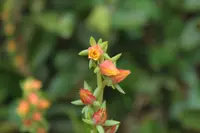
Echeveria bicolor is a compact succulent from Mexico, forming tight rosettes of fleshy, bicolored leaves with soft green centers and reddish margins. It stays relatively low and spreads slowly, making it suitable for small pots, dish gardens, and rock gardens in warm climates.
This species stores water in its leaves, so it tolerates short dry periods and suits beginner to intermediate growers. Understanding how to care for Echeveria bicolor mainly involves providing strong light, infrequent watering, and very well-drained, gritty soil.
In frost-free regions it can grow outdoors in containers or sunny beds, while in cooler areas it is usually kept indoors or in a bright greenhouse.

Care Difficulty
Easy Care

Light Preference
Full Sun

Water Requirements
Low Water

Temperature Preference
Tropical / Frost Sensitive

Hardiness Zone
10–11

Soil Texture
Sandy, Loamy, Rocky

Soil pH
Slightly acidic (6.5–7.0), Neutral (7.0)

Soil Drainage
Well-drained

Fertilization
Minimal (feed rarely)
Scan your plant to receive care tips personalized for your specific plant
Available on iOS and Android
This compact succulent prefers strong light to maintain tight rosettes and clear leaf color.
This species needs infrequent, deep watering and very fast-draining soil.
This succulent thrives in warm, dry conditions and dislikes frost and prolonged damp cold.
This succulent prefers dry air and typical indoor humidity rather than elevated levels.
Use a very fast-draining, mineral-rich mix to keep roots of Echeveria bicolor dry between waterings.
This species is well suited to container growing when excess moisture is controlled carefully.
This succulent needs only light feeding, as Echeveria bicolor is adapted to low-nutrient soils.
Pruning is minimal and mainly keeps Echeveria bicolor tidy and disease-free.
Container-grown Echeveria bicolor benefits from infrequent but careful repotting to maintain root health.
Echeveria bicolor is commonly propagated vegetatively to maintain desirable traits.
Winter care for Echeveria bicolor focuses on avoiding freezing temperatures and excess moisture.

Plant Health Check
Not sure what's wrong with your plant? Check your plant's health inside the app.
This species is naturally found on rocky slopes and cliffs in the Sierra Madre Oriental of Mexico, often growing in crevices where water drains very quickly and soils are mineral-rich and low in organic matter.
Mature rosettes typically show a clear bicolor effect, with bluish-green leaf centers contrasted by reddish to pink margins that intensify in strong light and cooler, drier conditions.
Its arching flower stalks carry tubular red-and-yellow flowers that are well suited to bird pollination, and in its native range they are frequently visited by hummingbirds seeking nectar.
Brown leaves usually result from sun scorch, prolonged underwatering, or old age. Crisp brown patches suggest too much intense sun, while uniformly dry, shriveled leaves indicate drought stress. Remove damaged leaves and adjust light exposure and watering rhythm.
Keep your plants happy and healthy with plant identification, disease detection, and easy care guidance.

Verode
Kleinia neriifolia
-1-200x132.webp) POPULAR
POPULARPonytail Palm
Beaucarnea recurvata
 POPULAR
Lavender Scallops
Kalanchoe fedtschenkoi
beach bells
Kalanchoe manginii
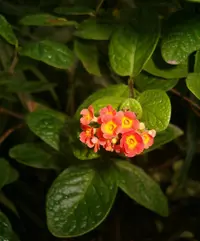
rondeletia
Rondeletia odorata
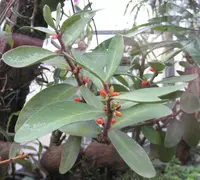
Hydnophytum formicarum
Hydnophytum formicarum
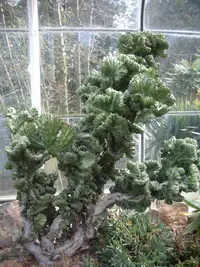
Elkhorn
Euphorbia lactea 'Cristata'
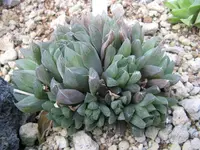
Haworthia cooperi var. pilifera
Haworthia cooperi var. pilifera