maguey Care (Agave atrovirens)

Also known as: pulque agave
maguey

About maguey

Maguey (Agave atrovirens) is a large, rosette-forming succulent native to highland regions of Mexico. It is traditionally grown for fiber, food uses, and landscaping. Thick, fleshy leaves with sharp spines form a dramatic architectural shape that can reach substantial size outdoors in warm climates. The plant flowers only once, producing a tall flowering stalk late in life. This species tolerates heat, sun, and drought, so it suits low-maintenance, dry gardens when given sharply drained soil. Its slow growth and strong spines are the main points to consider when planning how to care for maguey.

Main Plant Requirements

Care Difficulty

Easy Care

Light Preference

Full Sun

Water Requirements

Low Water

Temperature Preference

Tropical / Frost Sensitive

Hardiness Zone

9–11

Soil Texture

Sandy, Loamy, Rocky

Soil pH

Slightly acidic (6.5–7.0), Slightly alkaline (7.0–7.5)

Soil Drainage

Well-drained

Fertilization

Minimal (feed rarely)

Get Personalized Care Plan

Scan your plant to receive care tips personalized for your specific plant

Available on iOS and Android

How to Care for the maguey

Agave atrovirens thrives in strong sun but benefits from some protection during the hottest hours.

  • Provide 6–8 hours of direct sun daily, ideally with full morning sun and light or filtered afternoon sun, especially in hotter regions.
  • Plant maguey where it receives at least 4 hours of direct light in cooler climates; light shade is tolerated but growth becomes slower and more open.
  • Watch for pale, stretched leaves as a sign of too little light, and scorched, brown patches as a sign of intense, unrelieved midday sun.

Agave atrovirens requires infrequent, deep watering in well-drained soil.

  • Allow the top 5–8 cm of soil to dry completely before watering; in hot, dry seasons this may mean watering every 10–21 days, less often in cool weather.
  • Use very free-draining, gritty soil so water passes through quickly, preventing the roots from standing in moisture.
  • Shriveling, folding leaves suggest underwatering, while soft, yellowing leaves or a rotting crown indicate chronic overwatering or poor drainage.

This agave prefers warm, dry conditions and is sensitive to hard frost.

  • Aim for 70–90°F (21–32°C) during active growth, with low humidity and good air movement around the plant.
  • Mature plants can tolerate short drops to about 25°F (−4°C) if kept dry, but tissue damage increases rapidly near or below this point.
  • In very hot periods above 100°F (38°C), provide slight afternoon shade and avoid reflected heat from walls or pavement to reduce leaf scorch.

Humidity is rarely critical for Agave atrovirens, which thrives in dry indoor or outdoor air.

  • Aim for 20–40% relative humidity; avoid prolonged conditions above 60%, which can encourage rot.
  • Dry household air is usually suitable, but combine with strong light and well-drained soil to prevent moisture buildup at the roots.
  • If leaves of maguey show soft, dark patches, reduce ambient humidity, increase air movement, and allow the potting mix to dry more between waterings.

Agave atrovirens needs a very fast-draining, mineral-rich substrate to prevent root and crown rot.

  • Use a gritty, sandy mix, such as 50–70% inorganic components (pumice, perlite, coarse sand, small gravel) blended with 30–50% lean cactus mix.
  • Aim for slightly acidic to neutral pH, around 6.0–7.0, and avoid heavy clay-based garden soil that compacts and holds water.
  • Improve aeration by including large, irregular particles (pumice or crushed lava rock 5–10 mm) so air can move freely between roots.
  • Avoid peat-heavy, moisture-retentive potting mixes; if using bagged cactus soil, cut it with at least an equal volume of added mineral grit.

This species is suitable for container growing when given a stable, heavy, and well-drained pot setup.

  • Choose a wide, low, heavy container to counter the rosette’s top weight and reduce tipping in wind or from accidental bumps.
  • Select unglazed terracotta or another porous material if extra evaporation is needed to offset dense, mineral-rich mixes.
  • Raise the pot slightly on feet or bricks so water exits quickly from drainage holes and does not pool under the container base.

Agave atrovirens needs only light feeding, as it is adapted to poor, rocky soils.

  • Apply a diluted balanced NPK fertilizer (at 1/4–1/2 strength) once in mid to late spring to support new growth.
  • Use a slow-release cactus or succulent fertilizer, or a thin layer of well-aged compost, avoiding heavy organic mulches on the crown.
  • Skip feeding in fall and winter, when growth slows and excess nutrients can cause weak, frost-sensitive tissue.
  • For container plants, adjust any liquid feed to very low strength and ensure the potting mix drains rapidly, essential when caring for maguey.

Pruning Agave atrovirens is minimal and focuses on safety, plant health, and maintaining a clean rosette.

  • Carry out light pruning in late spring or summer, when the plant is actively growing and recovers fastest.
  • Remove only dead, damaged, or diseased leaves by cutting them close to the base without injuring the central growing point.
  • Use long-handled, sharp pruners and sturdy gloves to avoid injury from the rigid, spined leaves.
  • Limit removal of healthy leaves, as heavy pruning can distort the plant’s natural form and reduce vigor.

Large Agave atrovirens plants are usually grown in the ground, so transplanting is infrequent and should be planned carefully.

  • Transplant only when roots are circling the planting hole, growth is noticeably slowed, or the plant is clearly outgrowing its space.
  • Choose late spring to early summer, allowing warm conditions for root recovery in a sharply drained, gritty soil mix or sandy bed.
  • Water lightly 1–2 days before moving, lift with as much rootball as possible, and handle the stiff leaves cautiously.
  • Replant at the same depth, backfill with free-draining soil, stake if needed for stability, and keep soil barely moist until new growth resumes.

Agave atrovirens is most often propagated from offsets rather than seed, as this is faster and more reliable for home growers.

  • Separate well-formed offsets in late spring or early summer, when warm temperatures favor rapid root formation.
  • Use a clean, sharp knife to cut pups away from the mother plant, keeping some roots attached when possible.
  • Allow cut surfaces to dry and callus for 3–7 days in a shaded, airy place to reduce rot risk.
  • Plant offsets in a gritty, fast-draining cactus mix, water sparingly, and keep warm and bright until established.

Agave atrovirens prefers mild, dry winters and suffers damage in hard freezes, especially in wet soils.

  • In the ground, it generally needs reliably above-freezing winters; sustained temperatures below about 25°F can injure foliage.
  • Provide a gravel mulch around the base to keep the crown dry and improve winter drainage.
  • In regions with occasional freezes, tent the plant with a breathable frost cloth during cold nights to shield leaves from ice damage.
  • Move container-grown plants under cover or indoors to a bright, cool, dry spot before the first hard frost.

Care Tips

Rock mulch ring

Lay a 10–20 cm wide ring of coarse gravel or small rocks around the base to stabilize the rosette, keep the neck dry, and reduce soil splash that can lead to rot or leaf spotting.

Slope and drainage

If planting in heavy soil, build a low mound or plant on a slight slope so water always drains away from the crown, which is critical for long-term health when growing maguey outdoors.

Safe leaf handling

When trimming damaged leaves or working close to the plant, use long sleeves, eye protection, and thick gloves, and cut spines off removed leaves immediately to prevent injuries in the garden.

Pup selection control

Allow several offsets (pups) to form, then keep only 1–3 of the strongest and remove the rest with a clean, sharp knife so the main plant does not waste energy on overcrowded, weak shoots.

Winter rain protection

In regions with cool, wet winters, place a simple clear plastic or polycarbonate cover over the rosette to keep excess rain off while still allowing full light and airflow to reduce crown rot risk.

Common Pests and Diseases

Agave snout weevil

This pest bores into the base of the rosette and lays eggs; larvae tunnel inside, causing collapse and foul-smelling rot. Symptoms include yellowing, wilting, and a loose, wobbling plant that may fall over at the crown.

Solution

Remove and destroy heavily infested plants, including the root, to prevent spread, and discard soil from the immediate area. For nearby healthy agaves, keep soil dry, avoid wounds at the base, and in high-risk regions use a systemic insecticide drench in early spring according to label directions.

Agave mite

These microscopic mites feed in tight leaf crevices and the crown, causing distorted new growth, scarring, and sometimes witches’-broom-like clusters. Symptoms include rough, corky patches, deformed leaves, and slow, weak growth.

Solution

Isolate suspect plants, remove and discard the most deformed leaves, and avoid overhead watering that keeps the crown wet. In collections, dispose of severely affected plants and treat nearby specimens with a miticide labeled for eriophyid mites, ensuring coverage into leaf bases and repeating as the product instructions specify.

Scale insects

These insects appear as small, fixed bumps on leaves and the lower stem, sucking sap and weakening the plant over time. Symptoms include sticky honeydew, sooty mold on leaf surfaces, and gradual yellowing or dull, stressed foliage.

Solution

For light infestations, gently scrape off scales or wipe leaves with a cloth dipped in diluted insecticidal soap or 70% isopropyl alcohol, keeping solution off the soil as much as possible. In heavier cases, apply a horticultural oil or systemic insecticide labeled for ornamentals and repeat at intervals to target newly hatched crawlers, while also improving light and reducing excess fertilizer to discourage rapid, soft growth.

Bacterial soft rot

This disease causes watery, foul-smelling rot starting at wounds or the crown, quickly spreading through leaf bases. Symptoms include mushy tissue, oozing liquid, and a strong odor, often following damage or prolonged wet conditions.

Solution

Remove and discard the entire plant and any obviously contaminated soil, since the bacteria spread easily in moisture. For remaining nearby agaves, maintain sharp, clean tools, avoid overhead irrigation, keep the crown dry, and ensure very fast-draining soil to reduce future infections.

Anthracnose leaf spot

This disease produces tan to dark brown spots on leaves, often with a darker edge and sometimes forming larger blotches under humid or wet conditions. Symptoms include scattered lesions, premature leaf decline, and reduced appearance in landscape or container specimens.

Solution

Prune and discard affected leaves, keeping cuts into firm healthy tissue and sterilizing tools between plants. Reduce overhead watering, increase spacing for airflow, and where disease pressure is recurrent, use a copper-based or other labeled fungicide, applying at the first sign of spotting and repeating according to product directions, especially during warm, wet weather typical when caring for maguey outdoors.

Interesting Facts

Pulque source plant

This species is one of the traditional magueys used in central Mexico to produce pulque, a mildly alcoholic drink made by fermenting the plant’s sap, known as aguamiel.

Massive leaf rosette

It forms one of the largest rosettes in the genus, with thick bluish-green leaves that can create an imposing hemispherical clump in its native highland habitats of central and southern Mexico.

Highland habitat specialist

The species is naturally associated with semi-arid to subhumid highland zones in Mexico, where it grows on rocky slopes and open fields and tolerates high solar radiation and marked day–night temperature swings.

Botan icon

Did you know?

Agave atrovirens was historically planted around fields and homesteads in parts of Mexico not only for sap production but also as a living barrier, using its sharp terminal spines and dense rosettes to deter livestock and define property boundaries.

FAQs about maguey

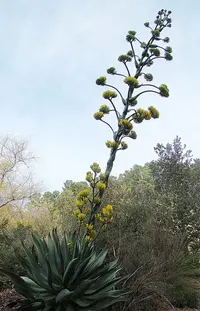
This species flowers only once when fully mature, often after several decades. Lack of flowering is usually normal. Flowering may be further delayed by cool temperatures, nutrient-poor soil, root restriction, or repeated removal of new leaves.

Grow Healthy Plants with Botan Care

Keep your plants happy and healthy with plant identification, disease detection, and easy care guidance.

Botan plant care app — identify plants on mobile

Explore More Plants