Promote strong offsets
Leave at least 5–10 cm of clear space around the rosette so pups can emerge and develop fully, then remove only the weakest or most crowded offsets with a clean, sharp knife to maintain airflow and plant vigor.

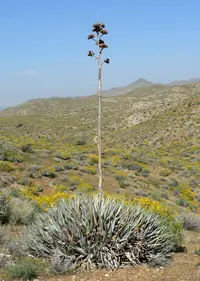
Desert agave (Agave deserti) is a small to medium rosette-forming succulent adapted to hot, dry environments. It stores water in thick, blue-green leaves with sharp spines along the edges and tip. Mature plants may send up a tall flowering stalk once in their lifetime, then slowly decline. This species is native to arid regions of the southwestern United States and northern Mexico, often growing on rocky slopes and desert washes. Its drought tolerance and slow growth make it relatively low-maintenance, but the spines and need for strong light require some planning. Sandy, fast-draining soil and minimal watering are usually enough to care for desert agave in suitable climates.

Care Difficulty
Easy Care

Light Preference
Full Sun

Water Requirements
Low Water

Temperature Preference
Warm Climate

Hardiness Zone
8–11

Soil Texture
Sandy, Loamy, Rocky

Soil pH
Slightly acidic (6.5–7.0), Neutral (7.0)

Soil Drainage
Well-drained

Fertilization
Minimal (feed rarely)
Scan your plant to receive care tips personalized for your specific plant
Available on iOS and Android
This species thrives in intense sun but benefits from slight protection during extreme heat.
This desert succulent is highly drought tolerant and needs infrequent, deep watering.
This species prefers hot, dry conditions but can tolerate a wide temperature range once established.
Humidity is not a significant factor for Agave deserti, which thrives in dry air typical of heated or air-conditioned homes.
Agave deserti requires very fast-draining, mineral-rich soil to prevent root rot and mimic its native desert habitat.
This species is suitable for container growing when the pot and substrate are managed to stay dry between waterings.
This hardy desert species needs only light, infrequent feeding in containers or poor soils.
Pruning for Agave deserti is minimal and focuses on hygiene and safety rather than shaping.
Container-grown plants are slow-growing and need infrequent repotting, while in-ground Agave deserti is usually transplanted only once to a permanent site.
Propagation of Agave deserti is most practical from offsets, with seeds used mainly for larger-scale or patient growers.
Mature Agave deserti is quite cold hardy in dry climates but benefits from some winter management in wetter or very cold regions.

Plant Health Check
Not sure what's wrong with your plant? Check your plant's health inside the app.
This species is native to the Sonoran and Mojave deserts, where its shallow, wide‑spreading roots rapidly absorb brief desert rainfalls before the water evaporates or drains away.
Mature plants commonly grow on open, rocky slopes and alluvial fans that can reach very high surface temperatures, surviving intense solar radiation that would quickly kill many other succulents.
It is often found on steep, gravelly or rocky substrates, where its dense rosette and fibrous roots help stabilize loose material and reduce erosion in harsh desert terrain.

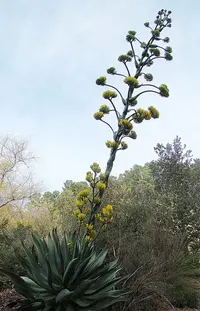
Agave deserti can live several decades and then flowers only once, sending up a tall branched stalk that can reach several meters in height, after which the rosette dies but leaves behind many offsets that continue the colony.
Brown leaf tips or patches usually come from sun scorch after sudden exposure, cold damage, or old age of outer leaves. Consistently soggy soil causes brown, mushy bases. Remove dead leaves and correct the underlying stress source.
Keep your plants happy and healthy with plant identification, disease detection, and easy care guidance.