Preventing crown rot
When planting, set the root ball on a slight mound or slope and keep the central rosette just above surrounding soil level so water always drains away from the crown and cannot pool inside the leaf cup.

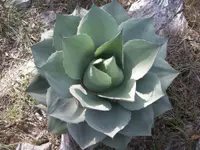
Whale's tongue agave (Agave ovatifolia) is a striking succulent rosette plant known for its broad, upward-curving, blue-gray leaves with shallow teeth along the margins. It forms a solitary, symmetrical clump that can become quite large over time, giving a strong architectural look in dry gardens.
This species is native to the mountains of northeastern Mexico, where it grows in rocky, well-drained sites with intense sun and low rainfall. It is valued for its high drought tolerance and relatively slow, predictable growth, which makes it straightforward to care for Whale's Tongue Agave in suitable climates.
The plant prefers bright light, lean mineral soil, and minimal watering, especially in cool or humid regions.

Care Difficulty
Easy Care

Light Preference
Full Sun

Water Requirements
Low Water

Temperature Preference
Cold Hardy

Hardiness Zone
7–10

Soil Texture
Sandy, Loamy, Rocky

Soil pH
Slightly acidic (6.5–7.0), Slightly alkaline (7.0–7.5)

Soil Drainage
Well-drained

Fertilization
Minimal (feed rarely)
Scan your plant to receive care tips personalized for your specific plant
Available on iOS and Android
This desert succulent thrives in bright, direct light with some protection from the harshest afternoon sun.
This drought-adapted species needs infrequent but deep watering and very sharp drainage.
This hardy agave tolerates a wide temperature range but prefers warm, dry conditions.
Humidity is not a significant factor for Agave ovatifolia, which thrives in dry air.
Agave ovatifolia prefers very fast-draining, mineral-based soil that mimics arid, rocky habitats.
This species is suitable for large, sturdy containers outdoors.
This drought-adapted succulent needs only light feeding, so focus on modest nutrition rather than rich soil amendments.
Agave ovatifolia needs minimal pruning, mainly to keep the rosette clean and safe to handle.
Container-grown or young landscape plants benefit from thoughtful transplanting that avoids disturbing the sensitive root system.
This species is slow and not usually multiplied in home gardens, so propagation is limited and often challenging.
This hardy agave tolerates significant cold but still benefits from thoughtful winter management in colder or wetter climates.

Plant Health Check
Not sure what's wrong with your plant? Check your plant's health inside the app.
This species is naturally found only in the mountains of Nuevo León, Mexico, where it grows on exposed limestone slopes and cliffs at relatively high elevations.
Unlike many agaves, it tolerates sustained subfreezing temperatures and short cold snaps well below 20°F, which has made Agave ovatifolia care instructions of special interest in temperate landscapes.
It forms a massive, symmetrical rosette that can reach over 1.5 m across, then flowers once at the end of its life on a tall, branched stalk before dying.

Agave ovatifolia was formally described only in 2002, after horticulturists recognized that cultivated plants in Texas and Mexico represented a distinct species that had gone unnoticed in the wild for a long time.
This species is monocarpic, meaning each rosette flowers only once, usually after many years. After the tall flower stalk finishes blooming and sets seed, that individual rosette dies and does not bloom again.
Keep your plants happy and healthy with plant identification, disease detection, and easy care guidance.