Early-season staking
Install sturdy stakes or a mesh support grid when shoots reach 20–30 cm to keep tall stems upright and prevent wind damage later in the season.

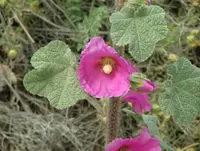
Bristly hollyhock (Alcea setosa) is a tall, short-lived perennial or biennial from the mallow family, valued for its upright spikes of large, saucer-shaped flowers. Stems and foliage are noticeably rough and hairy, which gives the plant its common name.
In its native range in the eastern Mediterranean and Middle East, it grows in open, sunny sites, often on dry, rocky or roadside soils. It tends to be hardy and wind-tolerant but dislikes prolonged waterlogging.
The plant is generally easy to grow if provided with full sun, well-drained soil, and moderate moisture. Understanding these simple needs helps clarify how to care for bristly hollyhock in typical garden conditions.

Care Difficulty
Moderate Care

Light Preference
Full Sun

Water Requirements
Moderate Water

Temperature Preference
Warm Climate

Hardiness Zone
6–9

Soil Texture
Sandy, Loamy

Soil pH
Slightly acidic (6.5–7.0), Neutral (7.0)

Soil Drainage
Well-drained

Fertilization
Minimal (feed rarely)
Scan your plant to receive care tips personalized for your specific plant
Available on iOS and Android
This sun-loving perennial thrives in bright, open positions with strong direct light.
This species prefers evenly moist but never waterlogged soil, especially during active growth and flowering.
This hardy garden perennial copes with a wide temperature range but grows best in moderate warmth.
Alcea setosa tolerates a wide humidity range and does not usually require special humidity management outdoors.
Alcea setosa prefers deep, well-drained, moderately fertile soil that does not stay waterlogged.
This species can be grown in large containers, but needs careful support and moisture management due to its tall, top-heavy growth.
Alcea setosa grows in modest soils, but moderate feeding improves flowering and overall vigor.
Pruning Alcea setosa helps maintain tidy growth and encourages stronger flowering the following season.
This species is usually grown in garden beds, so focus on careful transplanting rather than frequent repotting.
Alcea setosa is most often propagated from seed, which is straightforward under the right conditions.
Established plants are reasonably cold hardy and usually need only light winter care in most temperate regions.

Plant Health Check
Not sure what's wrong with your plant? Check your plant's health inside the app.
This species is naturally distributed in the eastern Mediterranean, particularly in parts of Israel, Lebanon, Syria, and nearby regions, where it grows in dry, rocky habitats and disturbed sites such as roadsides and field margins.
Leaves, stems, and flower buds are covered with coarse, stiff hairs, giving the plant a noticeably rough texture that helps reduce water loss and offers some protection against herbivores in its arid native environments.
The large, pale pink to rose flowers with darker veins are adapted to attract bees and other insects, which crawl over the central column of fused stamens, effectively transferring pollen between plants.

Genetic and morphological studies place this species within a group of Mediterranean hollyhocks that are considered important models for understanding how plants adapt to dry, high-light environments along relatively short geographic gradients.
This species performs best outdoors in open ground, where it receives strong light, good air movement, and deep soil. It can be short-lived or weak indoors, so bristly hollyhock indoor care is generally not recommended.
Keep your plants happy and healthy with plant identification, disease detection, and easy care guidance.

_(49532732922)-2-200x133.webp)