Control underground spread
Install a deep root barrier (at least 45–60 cm) around planting areas on loose soils to limit rhizome spread and make long‑term management of shoots easier.

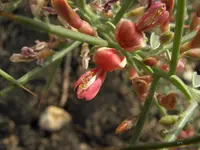
Camelthorn (Alhagi maurorum) is a deep-rooted perennial shrub from arid and semi-arid regions across North Africa, the Middle East, and parts of Asia. It belongs to the legume family and often forms dense, thorny thickets.
Plants are low, stiff, and much-branched, with small leaves and sharp spines along the stems. Pink to purplish pea-like flowers appear in summer, followed by narrow seed pods.
This species is highly drought tolerant and survives in poor, dry, often salty soils, which makes it tough but also invasive in some regions. These traits mean it is usually more important to control than to care for camelthorn in managed landscapes.

Care Difficulty
Easy Care

Light Preference
Full Sun

Water Requirements
Low Water

Temperature Preference
Cold Hardy

Hardiness Zone
4–9

Soil Texture
Sandy, Loamy, Rocky

Soil pH
Neutral (7.0), Alkaline (7.5–8.5)

Soil Drainage
Well-drained

Fertilization
Minimal (feed rarely)
Scan your plant to receive care tips personalized for your specific plant
Available on iOS and Android
Alhagi maurorum thrives in strong, direct sun typical of arid and semi-arid regions.
Alhagi maurorum is a deep-rooted desert shrub that prefers very dry conditions once established.
This desert-adapted shrub tolerates heat well but is sensitive to hard, prolonged frost.
Humidity is not a significant factor for this highly drought-adapted desert legume.
This desert shrub requires very lean, mineral soils with rapid drainage to prevent root decline.
This species can be grown in containers but requires careful control of root spread and moisture.
Alhagi maurorum is a tough desert legume that generally performs well with minimal fertilization in poor, dry soils.
Pruning Alhagi maurorum is mainly done for access, safety, and spread control rather than plant health.
This species is seldom grown in pots; management focuses on when and how to transplant or restrict its spread outdoors.
Propagation of Alhagi maurorum is straightforward but should be considered carefully, as the plant can become invasive.
This desert shrub is quite cold tolerant in dry conditions and usually needs little to no dedicated winter care in the ground.

Plant Health Check
Not sure what's wrong with your plant? Check your plant's health inside the app.
This species commonly develops roots that penetrate several meters into the soil, allowing it to reach deep groundwater and survive in extremely arid, saline habitats across central and western Asia and North Africa.
As a member of the legume family, it forms nodules on its roots with symbiotic bacteria that fix atmospheric nitrogen, enriching poor soils and helping it colonize degraded or disturbed land.
The shrub tolerates high soil salinity and prolonged drought, often dominating saline steppe and desert edges where many other vascular plants cannot persist.

In parts of its native range and in some areas where it has been introduced, this plant forms dense, thorny thickets that act as living barriers, altering grazing patterns of livestock and sometimes blocking irrigation canals and field access roads.
This species spreads vigorously by deep, wide-ranging roots and creeping rhizomes, especially in disturbed or irrigated soils. In suitable climates it can form dense thickets and is considered invasive in many agricultural and rangeland settings.
Keep your plants happy and healthy with plant identification, disease detection, and easy care guidance.