purple allamanda Care (Allamanda blanchetii)

Also known as: Violet allamanda
purple allamanda

About purple allamanda

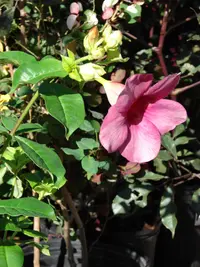
Purple allamanda (Allamanda blanchetii) is a fast-growing tropical vine or shrub valued for its large, trumpet-shaped purple flowers and glossy green leaves. It is often used on trellises, fences, or as a trained shrub in warm climates.

This species is native to Brazil and thrives in consistently warm, frost-free regions. It prefers bright light, moderate moisture, and well-drained soil, which makes it best suited for outdoor planting in mild to hot areas.

The plant grows vigorously under suitable conditions, so regular pruning is needed to manage its size and shape. With the right environment, it is relatively straightforward to care for purple allamanda, especially for gardeners familiar with sun-loving tropical ornamentals.

Main Plant Requirements

Care Difficulty

Moderate Care

Light Preference

Full Sun

Water Requirements

Regular Water

Temperature Preference

Tropical / Frost Sensitive

Hardiness Zone

10–11

Soil Texture

Sandy, Loamy, Organic-rich

Soil pH

Acidic (5.5–6.5), Slightly acidic (6.5–7.0)

Soil Drainage

Moist but well-drained

Fertilization

Moderate (every 2–4 weeks)

Get Personalized Care Plan

Scan your plant to receive care tips personalized for your specific plant

Available on iOS and Android

How to Care for the purple allamanda

This sun-loving vine needs strong, direct light to flower well outdoors.

  • Provide 6–8 hours of direct sun daily; morning to early afternoon sun is ideal for purple allamanda blooms.
  • Tolerates light afternoon shade, especially in hotter regions, but too much shade causes weak growth and few flowers.
  • In summer, introduce new plants to full sun gradually to prevent leaf scorch; in cooler months, avoid deep shade from buildings or trees that cuts light below 4 hours.

This species prefers consistently moist but not waterlogged soil during active growth.

  • Water when the top 3–5 cm of soil feels dry, applying enough to moisten the full root zone without leaving standing water.
  • Use well-drained soil and, if in the ground, avoid low spots where water collects; Allamanda blanchetii is prone to root rot in saturated conditions.
  • In cool seasons or when growth slows, extend the interval between waterings; watch for limp, curling leaves as a sign of underwatering and yellowing, mushy leaves as a sign of excess moisture.

This tropical vine thrives in warm, frost-free conditions year-round.

  • Optimal growth occurs at 70–85°F (21–29°C), with good flowering and steady vegetative growth in this range.
  • Plants are damaged below about 40°F (4°C) and usually killed by frost; protect or cover if a cold snap is forecast.
  • Heat-tolerant up to about 95°F (35°C) if soil moisture is stable, but prolonged extreme heat with dry soil can cause leaf scorch and bud drop, especially in exposed sites.

This species prefers moderate humidity but tolerates typical indoor air if not extremely dry.

  • Aim for 50–60% humidity for optimal foliage and flower development on purple allamanda.
  • Dry air below ~35% can cause leaf edge browning, curling, and slower growth.
  • Raise humidity by grouping plants, placing pots on a pebble tray with water below the pot base, or running a small humidifier nearby.

Allamanda blanchetii needs sharply drained, aerated soil that still holds moderate moisture.

  • Use a sandy or loamy mix with 30–40% coarse materials such as perlite, pumice, or fine bark to prevent waterlogging.
  • In pots, combine 50% peat- or coir-based potting mix with 25% perlite and 25% coarse sand for strong root aeration.
  • Target slightly acidic to neutral pH around 6.0–7.0, avoiding highly alkaline or saline soils that reduce nutrient uptake.
  • Avoid heavy clay or compacted ground; if planting in such areas, build a raised bed and amend generously with coarse sand and compost.

This species is suitable for containers if the pot supports its vigorous, climbing habit.

  • Choose a wide, heavy container to counterbalance top growth and support an attached trellis or obelisk.
  • Select a pot depth that allows a deep root run, roughly 2–3 times the height of the nursery rootball.
  • Use a potting mix that drains faster than in-ground soil since containers stay wetter at the base and can suffocate roots.

Allamanda blanchetii responds well to moderate, consistent feeding during its active growing season.

  • Use a balanced, water-soluble fertilizer (around 10-10-10 or 15-15-15) at half strength every 3–4 weeks in spring and summer.
  • Alternatively, apply a slow-release granular fertilizer at the start of spring, following label rates for flowering shrubs.
  • Pause feeding in late fall and winter when growth slows, especially in cooler regions or indoors.
  • Lightly amended compost can supplement nutrients but should not replace a balanced product for caring for purple allamanda.

Thoughtful pruning supports compact growth and abundant flowering on Allamanda blanchetii.

  • Time main pruning for late winter or very early spring before strong new growth begins.
  • Remove dead, diseased, or storm-damaged stems first, then thin overly crowded or crossing branches.
  • Shorten long, wandering shoots to control size and encourage bushier side branching and more flowers.
  • Use clean, sharp bypass pruners and make angled cuts just above outward-facing buds or leaf nodes.

Container-grown or newly planted Allamanda blanchetii benefits from careful transplanting to maintain vigorous growth.

  • Look for roots circling the pot, emerging from drainage holes, or slowed top growth as cues to move up 1 pot size.
  • Plan repotting or transplanting for late spring when soil is warm and frost risk has passed.
  • Expect container plants to need repotting about every 2–3 years, depending on growth rate and root density.
  • Water thoroughly before and after moving, keep the original root ball intact, and shade from intense sun for 3–5 days to limit transplant shock.

Allamanda blanchetii is most commonly propagated from semi-hardwood stem cuttings under warm, humid conditions.

  • Take 8–12 cm semi-hardwood cuttings in late spring or summer from non-flowering shoots.
  • Remove lower leaves, dip the cut base in rooting hormone, and insert into a moist, well-drained mix such as perlite and peat or coco coir.
  • Maintain bottom heat around 70–75°F, high humidity, and bright, indirect light until roots form in 3–6 weeks.
  • Seeds are possible but slower; sow fresh seed in warm conditions and keep the medium evenly moist but never waterlogged.

This tropical shrub is frost-tender and needs protection in regions with cool or freezing winters.

  • In USDA zones below 10, grow in containers and move indoors or to a heated greenhouse before nights drop below 50°F.
  • Outdoors in mild climates, apply a 5–8 cm mulch layer over the root zone to buffer temperature swings.
  • Avoid overhead watering during cold spells to reduce risk of stem damage and fungal issues.
  • Provide bright, cool indoor conditions in winter and reduce watering so the root zone stays slightly moist, not saturated.

Care Tips

Provide sturdy support

Install a strong trellis, fence, or wires before planting so long shoots can be tied loosely with soft ties as they grow, preventing wind damage and twisted stems.

Train and pinch shoots

Regularly pinch back the tips of young, soft shoots and direct main stems along the support to encourage a denser framework and more flowering spurs over time.

Mulch the root zone

Apply a 5–8 cm layer of coarse organic mulch around the base, keeping it a few cm away from the stem, to stabilize soil moisture and protect shallow feeder roots from heat stress.

Monitor for sap-suckers

Inspect new growth weekly for aphids, spider mites, and whiteflies, and rinse foliage with a firm stream of water or use horticultural soap at first signs to prevent distortion of buds and leaves.

Plan for seasonal protection

In regions with cool winters, grow Allamanda blanchetii in a large container that can be moved indoors before temperatures drop below 50°F, which simplifies caring for purple allamanda year after year.

Common Pests and Diseases

Spider mites

This pest often appears in hot, dry conditions and causes fine stippling, bronzing, and webbing on the undersides of leaves. Symptoms include dull, dusty foliage and premature leaf drop on purple allamanda vines.

Solution

Rinse foliage thoroughly with a firm stream of water, focusing on leaf undersides, and repeat several times over 7–10 days. If needed, apply insecticidal soap or a neem oil spray labeled for mites, and increase humidity and air circulation to make conditions less favorable for outbreaks.

Aphids

These insects cluster on soft new growth, buds, and stems, sucking sap and causing curled, distorted leaves and sticky honeydew that can attract sooty mold. This pest is often introduced by ants that farm them for honeydew on vigorous, leafy shoots.

Solution

Prune or pinch off heavily infested tips and wash remaining shoots with water to dislodge colonies. Follow with insecticidal soap or a light horticultural oil spray, and control nearby ant activity to reduce reinfestation.

Whiteflies

These insects congregate on the undersides of leaves and fly up in small clouds when the plant is disturbed, leading to yellowing leaves and reduced vigor. Sticky honeydew and secondary sooty mold can develop on dense purple allamanda foliage.

Solution

Use yellow sticky traps to monitor and reduce adult numbers, and regularly hose down foliage to remove nymphs. For persistent infestations, apply insecticidal soap or neem oil thoroughly to leaf undersides every 7–10 days until populations decline.

Leaf spot

This disease causes small brown to dark purple spots that may enlarge and merge, leading to tattered or yellowing leaves in warm, humid weather. Symptoms include more damage on older, lower leaves and in dense, poorly ventilated growth.

Solution

Remove and discard affected leaves, and avoid wetting foliage when watering, especially late in the day. Improve spacing and airflow around the vine, and in severe or recurring cases use a copper- or chlorothalonil-based fungicide labeled for ornamental leaf spots according to directions.

Powdery mildew

This disease produces a white to gray powdery coating on leaves, young stems, and sometimes flower buds, which can cause leaf distortion and reduced flowering. Symptoms include slower growth and an overall dull appearance on heavily shaded or crowded plants.

Solution

Increase sun exposure and airflow where possible, thinning excess shoots to reduce crowding. Remove heavily affected leaves and treat with a sulfur, potassium bicarbonate, or neem-based fungicide labeled for powdery mildew, applied at the first signs of infection and repeated as directed.

Interesting Facts

Purple flower pigments

The deep purple color of this species is due to high concentrations of anthocyanins, a group of water-soluble pigments that also help protect the flowers from intense sunlight and UV radiation.

Hummingbird and butterfly magnet

In warm climates, the tubular, nectar-rich flowers are frequently visited by hummingbirds and larger butterflies, which are able to reach the nectar deep inside the corolla and act as effective pollinators.

Poisonous milky sap

Like many members of the Apocynaceae family, it produces a white latex sap containing toxic compounds that deter herbivores and can irritate human skin on contact.

Botan icon

Did you know?

This species, native to northeastern Brazil, has become a popular ornamental in tropical and subtropical cities worldwide because its vigorous climbing habit and continuous warm-season blooming allow it to quickly cover trellises, fences, and pergolas with dense purple flowers.

FAQs about purple allamanda

Poor flowering usually relates to insufficient warmth, low light, or nutrient imbalance, especially excess nitrogen. Check that the plant is not rootbound, avoid heavy pruning at the wrong time, and use a balanced, bloom-supporting fertilizer during the growing season.

Grow Healthy Plants with Botan Care

Keep your plants happy and healthy with plant identification, disease detection, and easy care guidance.

Botan plant care app — identify plants on mobile

Explore More Plants