Wind exposure management
Plant in a spot that receives steady air movement but is sheltered from extreme, salt-laden gusts by a low wall, boulder, or wind-tolerant hedge to prevent leaf tearing on mature rosettes.

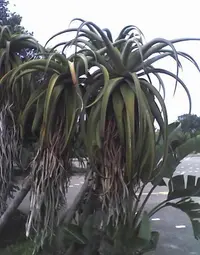
Dune aloe (Aloe thraskii) is a large, stem-forming succulent from coastal South Africa. It develops a tall trunk crowned with long, curved, gray-green leaves edged with small teeth. Mature plants produce showy, upright flower spikes in shades of yellow to orange that attract pollinators in mild climates. In the landscape it often forms a striking architectural focal point. This species comes from sandy, well-drained, seaside habitats exposed to strong light and wind. Its drought tolerance and preference for poor, fast-draining soil make it relatively straightforward for experienced growers to care for Dune Aloe, especially in warm, frost-free regions or protected coastal gardens.

Care Difficulty
Moderate Care

Light Preference
Full Sun

Water Requirements
Low Water

Temperature Preference
Tropical / Frost Sensitive

Hardiness Zone
10–11

Soil Texture
Sandy, Loamy, Rocky

Soil pH
Slightly acidic (6.5–7.0), Neutral (7.0)

Soil Drainage
Well-drained

Fertilization
Minimal (feed rarely)
Scan your plant to receive care tips personalized for your specific plant
Available on iOS and Android
This large coastal aloe needs strong light to develop a sturdy trunk and dense leaf rosette.
This species is drought tolerant and prefers infrequent, deep watering over light, frequent splashes.
This coastal aloe prefers warm, frost-free conditions but endures brief chills if kept dry.
This coastal aloe handles dry air well, so humidity is rarely a limiting factor indoors or outdoors.
This species needs very fast-draining, mineral-rich soil to prevent root rot and maintain firm growth.
This large, top-heavy aloe can be grown in containers if the pot is chosen for drainage and stability.
Aloe thraskii benefits from modest feeding in containers but established in-ground plants often grow well in lean, sandy soil.
Pruning Aloe thraskii is mainly hygienic, keeping the rosette clean and the trunk tidy.
Container-grown Aloe thraskii and young landscape plants need infrequent but careful repotting or transplanting.
Propagation of Aloe thraskii is usually done by seed, as mature plants rarely form offsets.
This coastal aloe tolerates only light frost and needs thoughtful winter care in colder climates.

Plant Health Check
Not sure what's wrong with your plant? Check your plant's health inside the app.
This species is naturally restricted to a narrow strip of sandy coastal dunes in KwaZulu-Natal and the Eastern Cape of South Africa, where it helps stabilize shifting sands with its strong root system.
It is adapted to withstand persistent salt spray and strong onshore winds, with thick, waxy leaves that reduce water loss and protect tissues from salt damage.
Mature plants develop a tall trunk topped by long, recurving leaves that bend downward in a uniform skirt-like canopy, a growth form that channels rainwater toward the stem and root zone.

In its native habitat, this species often forms part of the last living barrier between the ocean and inland vegetation, and its decline due to coastal development has made wild populations locally threatened in parts of its natural range.
This species is moderately fast for a large aloe. In warm coastal climates it may add 20–40 cm of trunk per year when young, slowing as it matures. Growth is much slower in cooler, drier, or container conditions.
Keep your plants happy and healthy with plant identification, disease detection, and easy care guidance.