Early staking support
Install a discreet stake or low wire support when shoots reach 20–30 cm so the tall, airy stems stay upright in wind and rain without snapping at the base.

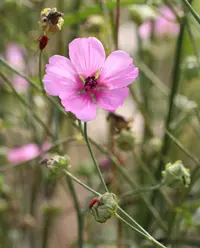
Palm-leaf marshmallow, Althaea cannabina, is a herbaceous perennial in the mallow family, valued mainly as a decorative garden plant. It forms tall, airy stems with finely divided, cannabis-like leaves and many small, pale pink flowers that give a light, transparent look in borders.
This species is native to dry, sunny habitats in southern and central Europe and parts of western Asia. It adapts well to poor or rocky soils, which makes it relatively undemanding once established.
The plant prefers full sun, free-draining soil, and moderate moisture, and it tolerates short dry periods. These traits make it straightforward for gardeners learning how to care for palm-leaf marshmallow.

Care Difficulty
Easy Care

Light Preference
Full Sun

Water Requirements
Moderate Water

Temperature Preference
Cold Hardy

Hardiness Zone
5–9

Soil Texture
Sandy, Loamy

Soil pH
Slightly acidic (6.5–7.0), Neutral (7.0)

Soil Drainage
Well-drained

Fertilization
Minimal (feed rarely)
Scan your plant to receive care tips personalized for your specific plant
Available on iOS and Android
This sun-loving perennial thrives in bright, open conditions with consistent direct light.
This species prefers moderately dry, free-draining conditions and is sensitive to prolonged wet soil.
This hardy perennial tolerates a wide temperature range but performs best in mild to warm conditions.
Althaea cannabina manages well in typical outdoor humidity and rarely needs special humidity control.
This species prefers light, well-drained soil that does not stay wet for long.
This species can be grown in containers if the pot is prepared to manage its tall, airy growth and deep roots.
This drought-tolerant perennial generally needs modest feeding, especially when grown in lean garden soils.
Pruning helps maintain a tidy shape and encourages flowering on Althaea cannabina.
This plant is usually grown in the ground, so focus on careful transplanting rather than frequent repotting.
Althaea cannabina is most often propagated from seed, with division or cuttings as secondary methods.
This hardy perennial usually requires minimal winter care in most temperate climates.

Plant Health Check
Not sure what's wrong with your plant? Check your plant's health inside the app.
This species is a wild European relative of the cultivated marshmallow plant and forms tall, very slender, much-branched stems that can reach around 1.5–2 m, giving it a notably airy, see-through appearance in meadows and dry slopes.
The species name cannabina refers to its divided, narrow leaf segments that resemble those of hemp (Cannabis), which makes the foliage visually distinct from the broad, velvety leaves of the common marshmallow Althaea officinalis.
In its native range, it flowers from mid to late summer into early autumn, producing many small pink flowers that provide nectar and pollen for bees and other insects when some earlier-flowering mallow relatives are already past their peak.

Althaea cannabina is sometimes used in naturalistic planting designs as a vertical, semi-transparent structural plant, because its fine, branching stems and small flowers allow wind, light, and views to pass through, adding height without creating a visual barrier.
Most parts of this species are considered non-toxic and have a history of traditional herbal use, especially roots and leaves. Only harvest from correctly identified plants in clean locations and consult a professional before using medicinally or in food.
Keep your plants happy and healthy with plant identification, disease detection, and easy care guidance.