Basket selection
Use a slatted wooden basket or open-sided plastic basket with coarse orchid mix so the long, pendulous inflorescences can hang freely without bending or snagging against a solid pot edge.

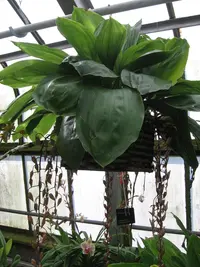
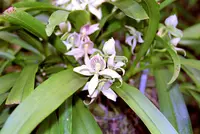
Gongora unicolor is an epiphytic orchid, usually growing on trees rather than in soil. It forms graceful, arching flower spikes with multiple hanging blooms. The flowers are typically uniform in color, giving the species its name, and have a delicate, often spicy or resinous fragrance. Plants grow from pseudobulbs that store water and nutrients, with thin leaves that signal a preference for stable, humid conditions.
In nature, Gongora unicolor occurs in tropical forests of Central and South America, where it enjoys warm temperatures, bright filtered light, and constant moisture. These traits make it rewarding but moderately challenging for beginners, especially outside greenhouse conditions. Understanding how to care for Gongora unicolor helps match its home environment more closely and improves long-term success.

Care Difficulty
Hard Care

Light Preference
Bright Indirect Light

Water Requirements
Keep Soil Moist

Temperature Preference
Tropical / Frost Sensitive

Hardiness Zone
Unknown

Soil Texture
Peaty, Organic-rich

Soil pH
Acidic (5.5–6.5)

Soil Drainage
Moist but well-drained

Fertilization
Moderate (every 2–4 weeks)
Scan your plant to receive care tips personalized for your specific plant
Available on iOS and Android
This orchid prefers bright, filtered light that mimics dappled forest shade.
This species prefers evenly moist conditions with brief drying at the surface between waterings.
This orchid thrives in warm to intermediate temperatures with stable conditions year-round.
This orchid needs high, stable humidity to maintain healthy foliage and flower spikes.
This species prefers a very open, airy medium that stays lightly moist but never compacted or waterlogged.
This orchid is very suitable for container growing, especially in baskets or ventilated pots.
Nutrient support improves flowering and overall vigor for Gongora unicolor in cultivation.
Pruning needs are minimal and focus on hygiene and maintaining good air flow around the plant.
This orchid resents frequent disturbance, so repotting focuses on media freshness and root health rather than pot size.
Propagation of this species is usually done by careful division rather than from seed in home settings.
This tropical orchid is not frost hardy and requires controlled indoor conditions during cold weather in temperate regions.

Plant Health Check
Not sure what's wrong with your plant? Check your plant's health inside the app.
Gongora unicolor produces pendent flower spikes with many small, uniform-colored flowers that release a stronger fragrance in the evening, likely timed to its natural pollinators’ activity patterns in tropical forests of Central America.
Its flowers bear compact pollen masses called pollinia that attach to visiting insects, a hallmark of many orchids, but in this species they are arranged so that only correctly positioned pollinators can remove and transfer them, increasing pollination precision.
The inflorescences arch downward so the flowers hang upside down, exposing the lip and column in a way that guides specific pollinators along a controlled path during landing and takeoff.
Lack of blooms usually comes from insufficient light, too-warm nights, or inadequate seasonal temperature drop. Crowded roots or skipped fertilizer can also reduce flowering. Provide stable humidity, good air movement, and a mild cool-down period to set spikes.
Keep your plants happy and healthy with plant identification, disease detection, and easy care guidance.