Mark Dormant Sites
Mark the exact spots of tubers with subtle pegs or labels in late summer so you avoid disturbing them during autumn and winter maintenance when the plant is completely dormant and invisible above ground.

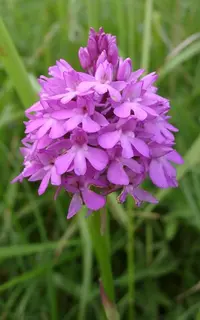
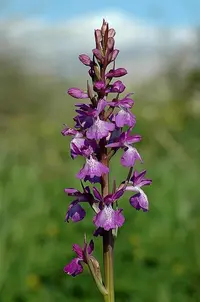
The pyramidal orchid, Anacamptis pyramidalis, is a small terrestrial orchid native to grasslands and open, sunny slopes across much of Europe and parts of western Asia. It forms a rosette of narrow leaves at the base and sends up a single, slender stem topped with a dense, pyramid-shaped cluster of pink to magenta flowers. The plant prefers well-drained, often calcareous soils and thrives in low to moderately fertile conditions, which can make it challenging in rich garden beds. It suits gardeners who are patient and can care for Pyramidal orchid in more naturalistic, meadow-style plantings rather than conventional, highly irrigated borders.

Care Difficulty
Hard Care

Light Preference
Full Sun

Water Requirements
Moderate Water

Temperature Preference
Cool Climate

Hardiness Zone
5–9

Soil Texture
Sandy, Loamy, Rocky

Soil pH
Acidic (5.5–6.5), Slightly acidic (6.5–7.0)

Soil Drainage
Well-drained

Fertilization
Minimal (feed rarely)
Scan your plant to receive care tips personalized for your specific plant
Available on iOS and Android
This terrestrial orchid prefers bright, open conditions similar to sunny meadows and light grassland.
Watering should support a moist, but never waterlogged, soil profile during active growth.
This hardy orchid experiences cool winters and mild to warm summers in its natural range.
This temperate terrestrial orchid tolerates typical indoor humidity but grows best with slightly moist air.
Soil for this orchid must be loose, well-drained, and low in organic matter, mimicking a dry meadow or calcareous grassland.
This species can be grown in containers if its specific root and drainage needs are met.
This terrestrial orchid is adapted to low-nutrient soils, so fertilizer use should be minimal and carefully controlled for Anacamptis pyramidalis.
Pruning needs are light and mainly focused on hygiene and seed control for Anacamptis pyramidalis.
This orchid is usually grown in the ground; transplanting small clumps is done infrequently and with care.
Propagation of Anacamptis pyramidalis is specialized, as it naturally relies on symbiotic soil fungi, so home success is limited.
This hardy terrestrial orchid usually needs little winter care in temperate climates.

Plant Health Check
Not sure what's wrong with your plant? Check your plant's health inside the app.
Its densely packed pyramidal flower spikes are adapted to attract day-flying butterflies and moths, which use their long proboscis to reach nectar deep in the floral spur and transfer pollen between plants.
This orchid depends on a symbiotic relationship with specific soil fungi (mycorrhizae) for seed germination and early growth, which is why it establishes best in undisturbed, low-fertilizer grasslands.
Flowers often shift from brighter pinkish hues to paler tones as they age, providing a visual cue to pollinators that fresher, more rewarding flowers are found on younger parts of the inflorescence.

This species produces tiny, dust-like seeds that lack nutrient reserves and cannot germinate on their own, relying entirely on compatible soil fungi to supply carbon and minerals during the earliest stages of development, which greatly limits where it can successfully colonize.
This species usually blooms from late spring to mid-summer, depending on climate. Flower spikes often remain attractive for 3–6 weeks, but individual blooms fade sooner. Cooler, stable conditions and undisturbed roots help extend the display.
Keep your plants happy and healthy with plant identification, disease detection, and easy care guidance.