


Prolong Bloom Period
Deadhead spent flower clusters every few days during peak bloom to encourage continuous flowering and prevent the plant from putting energy into seed production too early.

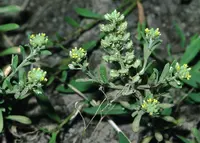
Small alison (Alyssum alyssoides) is a low-growing annual in the mustard family, forming small cushions or patches of fine foliage. It produces clusters of tiny yellow flowers that age to a pale color, giving a soft, muted look.
This species is native to parts of Europe and Asia but has naturalized widely in North America, often found in dry, disturbed ground and sandy soils. Its toughness, fast growth, and high seed production make it easy to establish but sometimes weedy in open sites.
It generally prefers full sun, well-drained soil, and relatively dry conditions, so it suits low-maintenance, informal spaces for those who want to care for small alison with minimal inputs.

Care Difficulty
Easy Care

Light Preference
Full Sun

Water Requirements
Low Water

Temperature Preference
Cold Hardy

Hardiness Zone
4–9

Soil Texture
Sandy, Loamy, Rocky

Soil pH
Slightly acidic (6.5–7.0), Slightly alkaline (7.0–7.5)

Soil Drainage
Well-drained

Fertilization
Minimal (feed rarely)
Scan your plant to receive care tips personalized for your specific plant
Available on iOS and Android
Alyssum alyssoides thrives in bright, open sites with plenty of direct sun.
This species prefers slightly dry conditions and is sensitive to consistently wet soil.
This annual is adapted to cool, dry climates but tolerates a fairly wide temperature range.
Humidity is rarely critical for Alyssum alyssoides, which thrives in dry, open air.
Alyssum alyssoides prefers lean, well-aerated, fast-draining soil that mimics dry, rocky ground.
This species is suitable for containers, especially shallow, free-draining pots on sunny patios or balconies.
Alyssum alyssoides is adapted to lean, well-drained soils and usually needs only light feeding in cultivation.
Pruning Alyssum alyssoides is simple and helps maintain compact growth and continuous flowering.
This species is usually grown as a short-lived annual or biennial, so transplanting young plants is more relevant than long-term repotting.
Alyssum alyssoides is most commonly propagated by seed, which germinates quickly in suitable conditions.
This plant is cold tolerant and often self-seeds, so in most climates it needs minimal winter care once established.

Plant Health Check
Not sure what's wrong with your plant? Check your plant's health inside the app.
This species naturally colonizes dry, stony, and gravelly soils, including disturbed sites like roadsides and railway embankments, where many other herbs struggle to establish.
It often flowers very early in the season, sometimes before many grasses fully leaf out, allowing it to complete much of its life cycle before competition for light and nutrients intensifies.
As a small annual, it relies on producing numerous tiny seeds that readily self-sow, forming short-lived but recurring populations in open, sun-exposed ground.
Leggy growth usually comes from too little light or from plants aging after flowering. This species is naturally short-lived, so stems elongate and thin out. Light trimming and reseeding are more effective than trying to reshape old plants.
Keep your plants happy and healthy with plant identification, disease detection, and easy care guidance.

Japanese Knotweed
Reynoutria japonica

sensitive jointvetch
Aeschynomene sensitiva
meadow alexanders
Zizia trifoliata
-200x150.webp)
Astragalus longidentatus
Astragalus longidentatus
Alchemilla murbeckiana
Alchemilla murbeckiana

Indian jointvetch
Aeschynomene indica
Fame Flower
Talinum paniculatum
Mexican heather
Cuphea hyssopifolia