
panther cap Identification (Amanita pantherina)

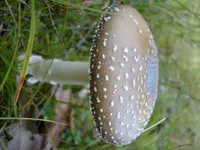
Recognize Amanita pantherina by its brown cap dotted with distinct white warts, a white stem with a skirt-like ring, and a bulbous base marked by raised concentric bands.

Most caps are about 2 to 6 inches (5 to 15 cm) across, with free white gills under the cap.

Amanita pantherina Identification

Check Your Plant with Botan

Upload a clear photo to check your plant identification with Botan.

Clear images work best. Avoid photos taken too close or too far away

Check the cap, stem, and base for a few visible features.

  • Cap is brown to olive-brown, usually 2 to 6 inches (5 to 15 cm) across, with scattered white warty patches.
  • Cap margin often shows fine radial grooves near the edge.
  • Gills are white, crowded, and free from the stem, not attached to it.
  • Stem is white with a skirt-like ring around the upper part.
  • Base is bulbous and shows distinct collar-like rings of tissue around the bulb.

The bulb and its ringed bands are especially useful to check before naming it Amanita pantherina.

This mushroom shows clear, useful visual changes from the button stage to maturity.

  • Young plant: Young fruit bodies emerge as rounded buttons, partly enclosed by a universal veil; the cap is still closed, with pale warts crowded over a dark surface.
  • Mature plant: As Amanita pantherina expands, the cap flattens to about 2-6 inches (5-15 cm) across, white gills are exposed, and a ring and bulbous base become easier to see.
  • Fruiting stage: At full fruiting, the stem stands slender beneath the open cap, while veil remnants separate into distinct white warts and a collar-like rim above the bulb.

Amanita pantherina is most visible from summer into fall, when the mushroom fruits above ground. That is the key seasonal clue, since it may be absent at other times. Fresh caps show white veil warts clearly; with age or rain, these can wash off, making late-season specimens look smoother and harder to recognize.

A few amanitas can be mistaken for Amanita pantherina at a glance.

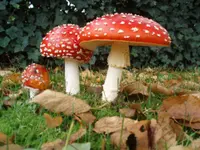
fly agaric(Amanita muscaria)

Both have caps with white warts and a ring on the stem. Fly agaric usually has a red, orange, or yellow cap, not brown, and its bulb base lacks the sharp collar-like rim typical of A. pantherina.

gemmed amanita(Amanita gemmata)

This species can share a tan to yellow-brown cap with white veil patches. It is usually paler overall, and the stem base is less distinctly marginate, without the strong rimmed bulb that helps separate panther cap.

Amanita pantherina is native to Europe and occurs across temperate parts of that region. It is most often found in broadleaf or mixed woodland, especially with beech, oak, birch, and sometimes conifers. Habitat is a useful clue because this species is typically a woodland mushroom rather than a grassland or wetland one. Finding it on the forest floor in established temperate woods helps narrow identification, especially when similar Amanita species are also possible.

  • Poisonous fruiting body: All parts of the mushroom, especially the cap and stem, are poisonous if eaten by humans or pets. The risk is ingestion, not normal skin contact.
  • High misidentification risk: Wrong identification among Amanita mushrooms is a serious poisoning hazard. A safety-critical comparison is Amanita rubescens: it typically shows pink to reddish bruising when damaged, while Amanita pantherina does not.

Does Your Plant Match?

Use Botan to compare a photo and help identify or confirm the species before you label it.

FAQ

For panther cap identification, compare bruising and cap warts. Amanita rubescens typically shows pink to reddish bruising on flesh or damaged areas, while this species does not. Its cap usually has crisp white warts and a more distinctly margined bulb.

More Plant Identification Guides

Find Out What Plant It Is

Identify it from a photo with Botan, then review plant details, safety notes, and common problems for that species.

Botan app identifying a plant from a photo
How to Winterize Your Garden in 6 Steps

5 min read · 28 Sept 2026

How to Winterize Your Garden in 6 Steps

Learn how to prepare your garden for winter with a practical six-step checklist covering cleanup, tender plant care, watering, mulching, winter protection, and winterizing equipment and containers.

Plant Care
How to Winterize Your Garden in 6 Steps
How Often to Water Fruit Trees

7 min read · 11 Aug 2026

How Often to Water Fruit Trees

Irrigation needs change as roots establish and weather shifts. This guide gives practical starting intervals, explains how soil and tree type change them, and shows how to recognize both excess moisture and drought stress.

Plant Care
How Often to Water Fruit Trees
Rice Water for Plants – Which Plants Love It and How to Make It

8 min read · 14 Jul 2026

Rice Water for Plants – Which Plants Love It and How to Make It

Rice water can be an ideal DIY solution for orchids, roses, or fruiting plants. It supports growth, leaf count, and height. We’ll share how to make and apply it correctly for your plant.

Plant Care
Rice Water for Plants – Which Plants Love It and How to Make It