Controlled spread management
Install a shallow root barrier strip 15–20 cm deep around beds or along paths to limit rhizome and seedling spread while still allowing the plant to naturalize in its designated area.

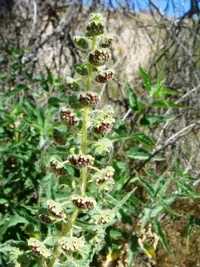
Big bur-sage, Ambrosia ambrosioides, is a hardy perennial herb or subshrub native to arid and semi-arid regions of the southwestern United States and northern Mexico. It usually grows in dry washes, open desert slopes, and disturbed ground.
Plants form loose, branching clumps with gray-green, aromatic foliage and small, inconspicuous flower clusters that later develop into spiny burs. The overall look is scrubby rather than decorative, but very resilient.
This species tolerates drought, poor soils, and high heat, which makes it relatively easy for low-maintenance, dry gardens. Understanding how to care for Big Bur-Sage mainly involves providing strong light, fast-draining soil, and avoiding excess moisture.

Care Difficulty
Easy Care

Light Preference
Full Sun

Water Requirements
Low Water

Temperature Preference
Warm Climate

Hardiness Zone
8–11

Soil Texture
Sandy, Loamy, Rocky

Soil pH
Slightly acidic (6.5–7.0), Slightly alkaline (7.0–7.5)

Soil Drainage
Well-drained

Fertilization
Minimal (feed rarely)
Scan your plant to receive care tips personalized for your specific plant
Available on iOS and Android
Ambrosia ambrosioides thrives in open, sunny sites typical of arid and semi-arid habitats.
This drought-adapted species prefers infrequent, deep watering once established.
This species is adapted to warm, dry climates with significant temperature fluctuations.
This desert-native shrub handles low indoor humidity easily and rarely needs special humidity care.
This species prefers dry, fast-draining, sandy soil that does not hold moisture around the roots.
This species can be grown in containers if the pot and substrate stay dry and well-aerated between waterings.
This drought-adapted native shrub usually needs minimal feeding, especially when grown in poor, well-drained soils typical for Big Bur-Sage habitats.
Pruning Ambrosia ambrosioides is useful mainly for tidying and managing size rather than for plant health.
This species is more often transplanted in the landscape than grown long term in containers.
Propagation of Ambrosia ambrosioides is mainly done by seed in suitable outdoor conditions.
This plant is generally cold hardy in its native range and needs little dedicated winter care.

Plant Health Check
Not sure what's wrong with your plant? Check your plant's health inside the app.
This species is naturally restricted to sandy and gravelly washes and arroyos in the Sonoran Desert region, where it tolerates periodic flash flooding followed by extended drought.
Its visible spikes are composed almost entirely of small, greenish male flower heads that release wind-dispersed pollen, while the less noticeable female flowers are tucked lower on the plant.
After flowering it forms hard, spiny burrs that can latch onto animal fur or be moved by flowing water, helping the seeds disperse through dry desert channels.

This ragweed relative is strongly associated with disturbed desert drainage habitats, and in some parts of its limited range it can act as a localized indicator of recent flood events and sediment movement in arid landscapes.
This species self-seeds freely and can spread quickly in open, disturbed ground. In suitable climates it may behave weedy. Remove spent flower heads before seed set and pull unwanted seedlings to prevent unwanted expansion.
Keep your plants happy and healthy with plant identification, disease detection, and easy care guidance.