Sheltered wind protection
Site the tree where it is shielded from strong, drying winds (for example near a wall or taller windbreak plants) to reduce leaf scorch and help delicate new growth develop fully.

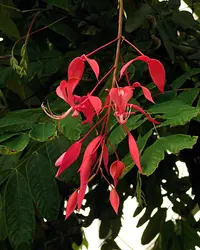
Pride of Burma (Amherstia nobilis) is a tropical flowering tree valued for its striking pendant clusters of red and yellow blossoms. It typically forms a small to medium tree with graceful, arching branches and delicate, divided leaves that emerge bronze before turning fresh green.
This species is native to humid forests of Myanmar and is considered rare in cultivation. It can be challenging to grow outside true tropical or warm subtropical climates, as it dislikes cold, wind, and drought.
Gardeners who care for Pride of Burma usually provide sheltered, bright conditions, evenly moist but well-drained soil, and consistent warmth to keep it healthy and flowering.

Care Difficulty
Hard Care

Light Preference
Partial Shade

Water Requirements
Keep Soil Moist

Temperature Preference
Tropical / Frost Sensitive

Hardiness Zone
11–12

Soil Texture
Loamy, Organic-rich

Soil pH
Acidic (5.5–6.5), Slightly acidic (6.5–7.0)

Soil Drainage
Moist but well-drained

Fertilization
Light (every 4–6 weeks)
Scan your plant to receive care tips personalized for your specific plant
Available on iOS and Android
Amherstia nobilis thrives in bright, filtered light that mimics high, open tropical canopy conditions.
Amherstia nobilis prefers evenly moist, well-drained soil that never stays saturated or bone dry.
This species needs warm, frost-free conditions to maintain healthy growth and flowering.
This species needs consistently high humidity to maintain healthy foliage and flowering.
Amherstia nobilis prefers deep, loose, organic-rich soil that drains freely yet holds steady moisture.
This tree can be grown in large containers when space or climate limits in-ground planting.
Amherstia nobilis benefits from modest, consistent nutrition rather than heavy feeding.
Pruning Amherstia nobilis focuses on safety, structure, and maintaining flowering wood.
This species is mostly grown in the ground, so care centers on careful transplanting rather than frequent repotting.
Propagation of Amherstia nobilis is challenging and mostly attempted by specialists rather than casual gardeners.
Amherstia nobilis is a tropical tree with very low frost tolerance, so winter protection is essential in cool climates.

Plant Health Check
Not sure what's wrong with your plant? Check your plant's health inside the app.
This species is believed to be native only to a small area in Myanmar, where it grows in lowland evergreen forests, making it one of the most geographically restricted leguminous trees in cultivation.
The tree produces long, hanging flower clusters with large, deep red petals and contrasting yellow markings, an arrangement that facilitates pollination by attracting birds with both color and accessible nectar.
It is the sole species in the genus Amherstia within the pea family (Fabaceae), which means its floral structure and growth habit represent a unique evolutionary line in this large plant family.

Historically, the tree has often been called the queen of flowering trees and was once grown mainly in royal or temple gardens in parts of Southeast Asia because of its rarity and highly ornamental flowers.
Lack of flowers usually comes from insufficient light, cool temperatures, or a plant that is still immature. Heavy pruning, nutrient-poor soil, or root stress also reduce flowering. Stable warmth and patient Amherstia nobilis care are essential.
Keep your plants happy and healthy with plant identification, disease detection, and easy care guidance.