Autumn cutback timing
Delay cutting back stems until late winter so the hollow stalks can protect dormant buds and provide some crown insulation through freeze–thaw cycles.

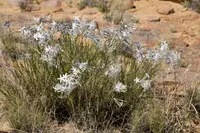
Tubular bluestar, Amsonia longiflora, is a clump-forming perennial known for its slender, tubular pale blue flowers and fine, narrow leaves. It typically forms low, airy mounds that fit well into naturalistic borders or prairie-style plantings.
This species is native to dry, open habitats in the south-central United States and northern Mexico, where it tolerates heat and seasonal drought. Its deep root system and tough foliage make it relatively low maintenance once established.
Gardeners who care for tubular bluestar value its long bloom period, good drought tolerance, and dependable structure. It generally prefers full sun to light shade, with well-drained, moderately moist soil.

Care Difficulty
Easy Care

Light Preference
Full Sun

Water Requirements
Moderate Water

Temperature Preference
Cold Hardy

Hardiness Zone
5–9

Soil Texture
Sandy, Loamy

Soil pH
Slightly acidic (6.5–7.0), Neutral (7.0)

Soil Drainage
Well-drained

Fertilization
Minimal (feed rarely)
Scan your plant to receive care tips personalized for your specific plant
Available on iOS and Android
Amsonia longiflora thrives in bright outdoor conditions with ample direct sun.
This deep-rooted perennial prefers evenly moist but not saturated soil, especially in its first growing seasons.
This hardy perennial is adapted to warm summers and cool to cold winters in the ground.
Humidity has little impact on Amsonia longiflora, which is well adapted to dry-air conditions.
Amsonia longiflora prefers lean, well-drained soil that mimics open prairie or rocky habitat.
This species can be grown in containers if the potting setup prioritizes sharp drainage and stability.
This drought-tolerant native, known as tubular bluestar, usually needs only light feeding in average garden soil.
Pruning Amsonia longiflora is simple and mainly helps maintain a tidy shape and healthy framework.
This species is usually grown in garden beds, so care focuses more on transplanting than on repotting.
Amsonia longiflora is most often propagated by seed or careful division of established clumps.
This perennial is generally cold hardy in much of its range and needs minimal winter attention in the ground.

Plant Health Check
Not sure what's wrong with your plant? Check your plant's health inside the app.
This species has unusually long, narrow corolla tubes compared with many other Amsonia species, which gives the pale blue, star-shaped flowers a distinctly tubular appearance adapted to long-tongued pollinators.
It is native to arid regions of the southwestern United States and northern Mexico, where it grows in sandy or gravelly soils and tolerates high light and periodic drought once established.
Like other members of the dogbane family (Apocynaceae), it produces a white latex sap that helps deter many herbivores, although it is not considered aggressively toxic to the touch in the way some relatives are.
This species is highly attractive to many pollinators. The tubular blue flowers provide nectar for native bees, small wasps, and butterflies, especially in late spring. Planting several together creates a more visible and rewarding nectar source.
Keep your plants happy and healthy with plant identification, disease detection, and easy care guidance.