Mark Dormant Clumps
Tag planting spots with discreet markers in late spring so the small clumps are not disturbed or accidentally dug up once the foliage disappears in summer.

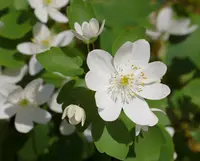
Rue-anemone, Anemonella thalictroides, is a small woodland perennial native to eastern North America. It appears in early spring and often finishes by summer heat. The plant forms delicate clumps with fine, fern-like foliage and nodding white or pale pink flowers held on slender stems. Each clump slowly expands, creating a soft, naturalistic groundcover in light shade. Rue-anemone prefers cool, humus-rich woodland soil that stays evenly moist but not soggy. It is considered moderately easy if given stable moisture, protection from strong sun, and minimal disturbance to its roots. Gardeners who learn how to care for rue-anemone usually find it reliable over many seasons.

Care Difficulty
Moderate Care

Light Preference
Partial Shade

Water Requirements
Regular Water

Temperature Preference
Cold Hardy

Hardiness Zone
4–8

Soil Texture
Loamy, Silty, Organic-rich

Soil pH
Acidic (5.5–6.5), Slightly acidic (6.5–7.0)

Soil Drainage
Moist but well-drained

Fertilization
Minimal (feed rarely)
Scan your plant to receive care tips personalized for your specific plant
Available on iOS and Android
This woodland perennial prefers soft, filtered light that mimics a deciduous forest edge.
This plant favors consistently moist but not waterlogged soil, especially during spring growth and flowering.
This species is adapted to temperate woodland climates with cool to mild growing seasons and cold winters.
This woodland perennial handles typical outdoor humidity but dislikes prolonged very dry air.
This species prefers loose, humus-rich, consistently moist but well-drained soil similar to woodland leaf litter.
This plant can be grown in containers if moisture and root coolness are managed carefully.
This woodland perennial needs only light feeding, as rue-anemone is adapted to naturally rich forest soils.
Anemonella thalictroides requires minimal pruning, mainly to keep clumps tidy and healthy.
This delicate woodland species is best left undisturbed and only transplanted when clearly necessary.
Anemonella thalictroides is usually propagated by careful division or by seed in controlled conditions.
This species is cold hardy in much of the US and usually needs little special winter care once established.

Plant Health Check
Not sure what's wrong with your plant? Check your plant's health inside the app.
This species survives winter as a small underground tuber, sending up foliage and flowers very early in spring before most woodland plants leaf out.
The showy white to pink structures that look like petals are actually sepals, while true petals are reduced and form nectar‑bearing glands inside the flower.
Its finely divided, bluish‑green leaves closely resemble those of meadow-rues in the genus Thalictrum, which is why it was historically shuffled between the genera Anemonella and Thalictrum in botanical classifications.

In much of its native range in eastern North America, this plant now persists mainly in undisturbed, old-growth or long-settled woodlands, so botanists often use its presence as an indicator of relatively intact, long-term forest habitat.
This species spreads slowly by short rhizomes and self-seeding. It usually forms small clumps rather than large colonies. In typical garden conditions it is not considered aggressive and rarely becomes difficult to control.
Keep your plants happy and healthy with plant identification, disease detection, and easy care guidance.