Windfirm shaping
In the first 2–3 years, lightly thin crowded interior branches and shorten the longest shoots by 10–20 cm after flowering so the shrub develops a sturdy, compact framework that resists wind damage and stem breakage.

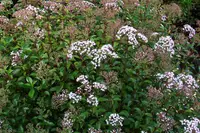
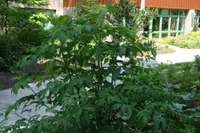
Privet-leaved ageratina (Ageratina ligustrina) is an evergreen shrub from the aster family, usually grown for its dense foliage and clusters of small white flowers. It forms a bushy, upright plant with glossy, privet-like leaves and a soft, clouded look when in bloom.
This species is native to mountainous regions of Mexico and Central America, where it grows in mild, moist conditions. In gardens, it is often used as a background shrub or informal hedge.
Gardeners generally find it moderately easy to care for privet-leaved ageratina when it is given bright light, regular moisture, and reasonably well-drained soil.

Care Difficulty
Moderate Care

Light Preference
Partial Sun

Water Requirements
Regular Water

Temperature Preference
Warm Climate

Hardiness Zone
9–11

Soil Texture
Loamy, Silty, Organic-rich

Soil pH
Acidic (5.5–6.5), Slightly acidic (6.5–7.0)

Soil Drainage
Moist but well-drained

Fertilization
Minimal (feed rarely)
Scan your plant to receive care tips personalized for your specific plant
Available on iOS and Android
This shrub prefers bright outdoor conditions with protection from harsh extremes of sun exposure.
This plant prefers evenly moist, well-drained soil without long, soggy periods or complete drying.
This species grows best in mild, frost-free climates with moderate warmth most of the year.
This species prefers moderate humidity but adapts to many home and garden conditions.
This shrub prefers moisture-retentive yet freely draining soil with moderate fertility.
This species can be grown in containers if the pot is sized and weighted to support its shrubby growth.
This shrub responds well to modest, balanced feeding during the main growing season.
Thoughtful pruning helps Ageratina ligustrina maintain a dense, flowering shrub form.
This species is usually grown in the ground, so care focuses on thoughtful transplanting and occasional container shifts.
Propagation is usually done from semi-ripe cuttings, with seeds as a secondary option for Ageratina ligustrina.
This shrub is moderately frost tolerant but benefits from basic winter preparation in colder regions.

Plant Health Check
Not sure what's wrong with your plant? Check your plant's health inside the app.
This shrub is naturally found in humid montane cloud forests from Mexico to Central America, where it grows on cool, misty slopes and forest edges rather than in lowland habitats.
Its dense heads of small white flowers appear in late fall to winter in mild climates, providing nectar for butterflies, moths, and other insects when many other flowering plants are dormant.
The common name privet-leaved ageratina comes from its glossy, narrowly elliptic leaves, which resemble those of true privets (Ligustrum) despite belonging to a different plant family.

This species has been recorded as naturalized and locally invasive in some mild coastal regions outside its native range, such as parts of New Zealand, where its vigorous growth and abundant seed production allow it to spread into disturbed forest margins.
The flowers are rich in nectar and strongly attract bees, butterflies, and other pollinating insects. In mild climates, it can provide a long nectar season, making it useful for wildlife-friendly gardens and ecological planting schemes.
Keep your plants happy and healthy with plant identification, disease detection, and easy care guidance.