Mounting strategy
Mount plants on cork or hardwood with a thin pad of long-fiber sphagnum only at the roots, leaving leaves fully exposed so they dry quickly and resist rot in warm, humid setups.

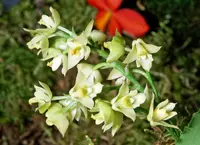
Polystachya cultriformis, commonly called powder orchid, is a compact epiphytic orchid that typically grows on tree trunks and branches. It forms small clumps with narrow, blade-like leaves and short spikes of delicate, pale flowers.
This species is native to parts of tropical Africa, where it experiences warm temperatures, bright but filtered light, and good air movement. Its small size and slow to moderate growth make it suitable for growers with limited space.
The plant prefers mounting or very free-draining orchid media and consistent, gentle moisture rather than heavy, wet potting soil. Understanding these natural conditions helps clarify how to care for Powder Orchid in a home or greenhouse setting.

Care Difficulty
Hard Care

Light Preference
Partial Shade

Water Requirements
Keep Soil Moist

Temperature Preference
Tropical / Frost Sensitive

Hardiness Zone
Unknown

Soil Texture
Peaty, Organic-rich

Soil pH
Acidic (5.5–6.5)

Soil Drainage
Moist but well-drained

Fertilization
Light (every 4–6 weeks)
Scan your plant to receive care tips personalized for your specific plant
Available on iOS and Android
This compact orchid prefers bright, filtered light that mimics high, airy forest conditions.
This species prefers consistent moisture around the roots but is sensitive to stagnant, soggy conditions.
This orchid grows best in intermediate to warm conditions with only mild temperature swings.
This orchid prefers moderately high, stable humidity to maintain healthy foliage and roots.
This epiphytic orchid requires a loose, airy medium rather than regular potting soil.
This species adapts well to container growing when the pot supports its epiphytic root system.
This orchid benefits from light, consistent feeding during active growth, but excess fertilizer harms its fine roots.
Pruning needs for Polystachya cultriformis are minimal and focus on hygiene rather than reshaping the plant.
This species prefers a snug pot and should be disturbed as little as possible to avoid root setback.
Propagation of this orchid is usually done by careful division rather than by seed in home settings.
This orchid is frost-sensitive and needs warm, protected conditions through winter in most climates.

Plant Health Check
Not sure what's wrong with your plant? Check your plant's health inside the app.
This species grows as a small epiphyte, anchoring on tree bark rather than in soil, and forms tight clumps of short, flattened pseudobulbs with narrow, blade-like leaves.
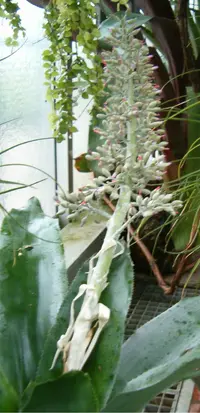
Its many small yellowish to greenish flowers are borne on a strongly compressed, often zigzagging inflorescence, giving the spike a noticeably flattened, fan-like look compared with more typical orchid sprays.
The species is naturally found in montane forests of tropical Africa, including parts of East and Central Africa, where it often grows in cool, moist, high-elevation cloud forest environments.
Lack of blooms often comes from insufficient light, too little temperature drop between day and night, or nutrient imbalance. Older, overcrowded plants may also flower less and benefit from division to stimulate new growth and spikes.
Keep your plants happy and healthy with plant identification, disease detection, and easy care guidance.