Mounting technique
Mount plants on hardwood slabs or cork with a thin layer of sphagnum only around the roots, leaving canes exposed so they dry quickly and stay better aerated in warm, wet climates.

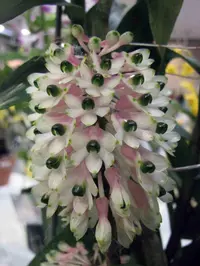
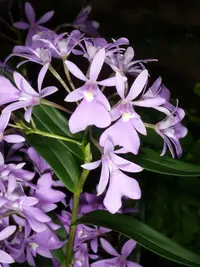
The bottlebrush orchid, Dendrobium smillieae, is an epiphytic orchid that typically grows on trees, forming clumps of upright, cane-like stems. Its dense flower spikes resemble bottlebrushes, with many small blossoms packed tightly around the stem, often in white, cream, or pink tones.
This species is native to tropical and subtropical forests of northern Australia and nearby regions, where it enjoys warm, humid, bright conditions with moving air. It can be moderately challenging for beginners, mainly due to its need for consistent moisture without waterlogging and good light without harsh scorch.
Those who learn how to care for Bottlebrush orchid usually find it rewarding, as a healthy plant can produce striking floral displays in the right conditions.

Care Difficulty
Hard Care

Light Preference
Partial Sun

Water Requirements
Regular Water

Temperature Preference
Tropical / Frost Sensitive

Hardiness Zone
11–12

Soil Texture
Rocky, Organic-rich

Soil pH
Acidic (5.5–6.5)

Soil Drainage
Well-drained

Fertilization
Moderate (every 2–4 weeks)
Scan your plant to receive care tips personalized for your specific plant
Available on iOS and Android
This orchid prefers bright, filtered light that mimics high, lightly shaded forest canopies.
This epiphytic orchid prefers moist but airy conditions around its roots rather than constant wetness.
This warm-growing orchid benefits from stable, frost-free temperatures year-round.
This epiphytic orchid prefers consistently moist air and reacts quickly to dry indoor conditions.
This species grows best in a very loose, airy, bark-based medium that mimics its epiphytic habit.
This species is well suited to container growing when the pot supports its upright, sometimes top-heavy canes.
Dendrobium smillieae benefits from light, consistent feeding during active growth but reacts poorly to heavy fertilization.
Pruning Dendrobium smillieae focuses on hygiene and light shaping rather than heavy cutting.
This epiphytic orchid prefers slightly tight conditions and is repotted infrequently to avoid root disturbance.
Propagation of Dendrobium smillieae is usually done on mature plants and requires stable warm conditions.
This warm-growing orchid is frost sensitive and needs mild winter conditions, especially in containers.

Plant Health Check
Not sure what's wrong with your plant? Check your plant's health inside the app.
This orchid produces dense cylindrical flower spikes whose individual blooms are arranged so closely that they resemble a bottlebrush, which is the origin of its common name bottlebrush orchid.
The flowers produce copious nectar that attracts ants and other insects, which move among the blooms and can assist with pollination as they search for sugar-rich droplets.
Its upright, cane-like pseudobulbs are often hollow and segmented, an adaptation that helps store water and maintain structural support in exposed rainforest canopy positions.

Some populations with pale or greenish-yellow flowers were once described under a separate name, but later taxonomic work placed them within the natural color variation of Dendrobium smillieae rather than as a distinct species.
Lack of flowering often comes from insufficient light, too-warm nights, or skipping a cooler, slightly drier rest after growth finishes. Crowded, old canes can also reduce spikes; careful division and Dendrobium smillieae care usually restore blooms.
Keep your plants happy and healthy with plant identification, disease detection, and easy care guidance.