Pinch For Bushiness
Regularly pinch out soft stem tips above a leaf pair every 3–4 weeks during active growth to keep the plant compact and encourage many flowering shoots instead of a few tall stems.

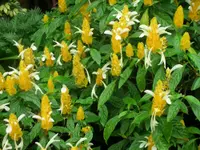
The golden shrimp plant, Pachystachys lutea, is a tropical flowering shrub valued for its tall yellow bracts that resemble shrimp, with small white flowers emerging between them. It stays compact in containers and can be shaped easily, which makes it suitable for patios, bright sunrooms, or seasonal indoor display.
This species comes from warm, humid regions of Central and South America, where it grows in bright, filtered light. It is considered relatively easy to grow if its basic needs for warmth, regular moisture, and well-draining soil are met. Understanding how to care for golden shrimp plant mostly involves providing stable light, avoiding cold drafts, and preventing waterlogged roots.

Care Difficulty
Moderate Care

Light Preference
Partial Sun

Water Requirements
Keep Soil Moist

Temperature Preference
Tropical / Frost Sensitive

Hardiness Zone
10–11

Soil Texture
Loamy, Sandy, Organic-rich

Soil pH
Acidic (5.5–6.5), Slightly acidic (6.5–7.0)

Soil Drainage
Moist but well-drained

Fertilization
Moderate (every 2–4 weeks)
Scan your plant to receive care tips personalized for your specific plant
Available on iOS and Android
This subtropical shrub prefers bright, gentle light to support continuous flowering.
This plant prefers evenly moist conditions but reacts poorly to waterlogged soil.
This tropical species grows best in warm, stable temperatures without cold drafts or frost.
This species prefers moderately high humidity and reacts if air stays very dry.
Pachystachys lutea grows best in a loose, airy mix that drains quickly but stays lightly moist.
This species is well suited to container growing when the pot controls moisture and supports its upright growth.
Pachystachys lutea responds well to moderate, consistent feeding during its active growing season.
Pruning Pachystachys lutea maintains a compact shape and supports heavier flowering.
Container-grown plants benefit from periodic repotting to maintain root health and sustained flowering.
Pachystachys lutea is most commonly propagated from softwood stem cuttings taken during the growing season.
This tropical shrub is frost-sensitive and needs protection in climates with cold winters.

Plant Health Check
Not sure what's wrong with your plant? Check your plant's health inside the app.
The showy yellow structures are not the flowers but long-lasting bracts that can remain attractive for weeks while the small white tubular flowers appear briefly and are quickly shed.
In its native range of tropical Peru, the narrow white flowers are adapted for pollination by long-tongued insects and possibly hummingbirds, which can reach the nectar hidden deep within the corolla tube.
In consistently warm, humid climates, this species can flower almost continuously rather than in one short seasonal flush, making it a dependable ornamental in tropical and subtropical gardens.

Pachystachys lutea is part of the Acanthaceae family, a group known for complex flower structures that often include specialized hairs and nectar guides, and this species shows these features in a simplified form that has made it a classic model in ornamental breeding and basic floral morphology teaching collections.
Lack of blooms usually comes from insufficient light, old non-productive stems, or nutrient imbalance. Provide bright conditions, avoid heavy high-nitrogen fertilizing, and prune lightly after flowering to stimulate new growth that carries buds when caring for golden shrimp plant.
Keep your plants happy and healthy with plant identification, disease detection, and easy care guidance.