Berry load management
If branches bend under the weight of berries, thin out some fruit clusters with clean scissors to prevent breakage and redirect energy into healthy foliage and root growth.

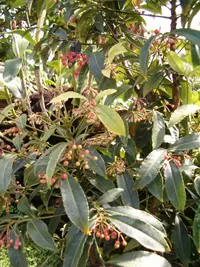
Christmas berry (Ardisia crenata) is an evergreen shrub grown mainly for its glossy foliage and long-lasting red berries. It stays relatively compact in containers, which makes it suitable for indoor display in bright rooms. In nature it grows in warm, shady forest understories in East and Southeast Asia.
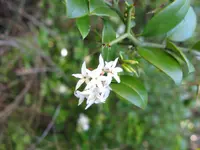
The plant produces clusters of small white to pink flowers, followed by berries that can persist for many months. It tends to be slow-growing but long-lived when conditions are stable. To care for Christmas berry, provide consistent moisture, a well-drained potting mix, and protection from harsh direct sun.

Care Difficulty
Moderate Care

Light Preference
Partial Shade

Water Requirements
Keep Soil Moist

Temperature Preference
Tropical / Frost Sensitive

Hardiness Zone
8–11

Soil Texture
Loamy, Peaty, Organic-rich

Soil pH
Acidic (5.5–6.5), Slightly acidic (6.5–7.0)

Soil Drainage
Moist but well-drained

Fertilization
Light (every 4–6 weeks)
Scan your plant to receive care tips personalized for your specific plant
Available on iOS and Android
Ardisia crenata grows best in bright, indirect light that mimics dappled woodland shade.
This species prefers evenly moist but not saturated soil throughout the active growing season.
This shrub prefers mild, frost-free conditions with stable, moderate temperatures.
This species prefers moderately humid air but usually adapts to typical home conditions.
Ardisia crenata grows best in slightly acidic, moisture-retentive yet well-drained soil.
This shrub is well suited to container growing for patios, balconies, or sheltered outdoor spots.
Ardisia crenata benefits from light, consistent nutrition but is sensitive to excess salts.
Pruning Ardisia crenata is mainly used to maintain a compact shape and remove weak growth.
Container-grown plants benefit from occasional repotting to maintain healthy roots and moderate growth.
Ardisia crenata is commonly propagated from semi-ripe cuttings and seeds.
This species is only mildly frost tolerant and benefits from thoughtful winter management, especially in cold climates.

Plant Health Check
Not sure what's wrong with your plant? Check your plant's health inside the app.
This species retains its glossy leaves year-round while carrying clusters of bright red berries that can persist on the plant for many months, sometimes overlapping with the next flowering season.
In parts of the southeastern United States, this plant has escaped cultivation and become invasive, forming dense understory thickets that reduce native plant diversity in forests and riparian areas.
The roots form small nodules that host beneficial microorganisms, which are thought to help the plant cope with low-nutrient, acidic soils in its native East Asian forests.

In Japanese New Year traditions, this species is often grown as a decorative pot plant called manryo, valued for its long-lasting red berries that symbolize continuing prosperity into the coming year.
Yellowing leaves often result from excess water, poor drainage, or compacted soil reducing oxygen at the roots. It can also follow sudden light changes or nutrient imbalance. Check drainage first, then adjust watering and repot if roots are crowded.
Keep your plants happy and healthy with plant identification, disease detection, and easy care guidance.