Mark Dormant Clumps
Insert small, durable labels where clumps grow before foliage dies back in late spring so you avoid disturbing or damaging the dormant rhizomes during later digging or replanting.

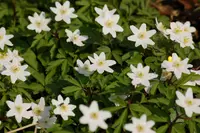
Wood anemone, Anemonoides nemorosa, is a low, rhizome-forming woodland perennial known for its early spring flowers. It forms carpets of delicate, white, star-like blooms above deeply divided green leaves. Native to European and parts of western Asian woodlands, it thrives in cool, dappled shade and naturally spreads slowly over time. The plant is relatively undemanding once established but dislikes disturbance, drying out, or very heavy, waterlogged soil. Gardeners who want to care for wood anemone should provide humus-rich, well-drained soil and a sheltered, partially shaded position that mimics a deciduous woodland floor.

Care Difficulty
Moderate Care

Light Preference
Partial Shade

Water Requirements
Regular Water

Temperature Preference
Cold Hardy

Hardiness Zone
4–8

Soil Texture
Loamy, Peaty, Organic-rich

Soil pH
Acidic (5.5–6.5), Slightly acidic (6.5–7.0)

Soil Drainage
Moist but well-drained

Fertilization
Minimal (feed rarely)
Scan your plant to receive care tips personalized for your specific plant
Available on iOS and Android
This woodland perennial prefers soft, filtered light similar to a deciduous forest floor.
This rhizomatous perennial favors consistently moist but not saturated soil during active growth.
This species is adapted to cool, temperate woodland climates with pronounced seasons.
Humidity is not a major factor for Anemonoides nemorosa when grown outdoors in typical temperate climates.
This woodland perennial prefers loose, humus-rich soil that stays moist yet drains freely.
This species can be grown in containers, but performance is best when the setup mimics cool, moist woodland soil conditions.
This woodland perennial needs minimal feeding, as wood anemone is adapted to low-nutrient soils.
Anemonoides nemorosa requires almost no structural pruning, only light cleanup to maintain plant health.
This species is usually grown in the ground and is moved by lifting and transplanting clumps rather than frequent repotting.
Anemonoides nemorosa is most often propagated by division of rhizomes rather than from seed.
This hardy woodland perennial needs little winter care in most temperate climates.

Plant Health Check
Not sure what's wrong with your plant? Check your plant's health inside the app.
Wood anemone is a classic spring ephemeral, completing most of its growth and flowering before trees fully leaf out and shade the forest floor.
Clonal colonies in old woodlands expand mainly by rhizomes and can take many decades to form dense flowering carpets, which is why the species is often used as an indicator of ancient woodland in parts of Europe.
Although flowers are typically white in much of its range, populations can show regionally characteristic tints of pink, purple, or blue, and horticultural forms with these colors have been selected for gardens by people interested in growing wood anemone.

Genetic studies show that many large wood anemone colonies in European forests consist of very few, sometimes even a single, long-lived clone, meaning thousands of individual-looking plants can actually be parts of the same genetically identical organism connected by underground rhizomes.
This species spreads slowly by slender rhizomes, forming loose carpets over several years. It is not usually aggressive in temperate gardens and is unlikely to overwhelm established perennials if given partial shade and undisturbed soil.
Keep your plants happy and healthy with plant identification, disease detection, and easy care guidance.