Stanhopea graveolens Care

Stanhopea graveolens

About Stanhopea graveolens

Stanhopea graveolens is an epiphytic orchid known for its large, pendant flower spikes and very fragrant, short-lived blooms. It typically grows in hanging baskets so the flower stems can emerge downward.

This species occurs naturally in humid forests of Central America, where it grows on trees in filtered light and high air humidity. Its showy flowers and need for consistent moisture and airflow make it more suitable for growers with some orchid experience.

Understanding how to care for Stanhopea graveolens starts with providing bright shade, good ventilation, and a very open, quickly draining potting mix that allows the roots to dry slightly between waterings.

Main Plant Requirements

Care Difficulty

Hard Care

Light Preference

Partial Shade

Water Requirements

Regular Water

Temperature Preference

Tropical / Frost Sensitive

Hardiness Zone

11–12

Soil Texture

Peaty, Organic-rich

Soil pH

Acidic (5.5–6.5)

Soil Drainage

Moist but well-drained

Fertilization

Moderate (every 2–4 weeks)

Get Personalized Care Plan

Scan your plant to receive care tips personalized for your specific plant

Available on iOS and Android

How to Care for the Stanhopea graveolens

This orchid prefers bright, filtered light that mimics dappled forest shade.

  • Provide 6–8 hours of bright, indirect light daily, such as under shade cloth or beneath high tree canopy.
  • Allow gentle morning sun but protect from strong midday and afternoon sun, which can scorch leaves and reduce flower quality in Stanhopea graveolens.
  • In summer, increase shading; in winter, move to a slightly brighter position to compensate for shorter days, avoiding deep shade that causes weak, floppy growth.

Watering should keep the roots moist but never stagnant in this epiphytic orchid.

  • Water thoroughly when the top 2–3 cm of the medium feels just barely dry, allowing excess to drain completely.
  • Increase watering frequency in active growth and warm weather, then reduce slightly after flowering and in cooler months while never letting pseudobulbs shrivel.
  • Watch for signs of stress: yellowing, soft bulbs indicate overwatering and poor drainage, while wrinkled bulbs and crisp leaf tips indicate underwatering.

This species prefers intermediate to warm temperatures with good air movement.

  • Aim for 65–80°F (18–27°C) by day and 55–65°F (13–18°C) at night for steady growth and reliable flowering.
  • Protect from cold; brief drops to 45°F (7°C) may be tolerated, but prolonged exposure below 50°F (10°C) can damage roots and pseudobulbs.
  • In hot periods above 85°F (29°C), increase shade, air circulation, and humidity to reduce heat stress and prevent bud blast in Stanhopea graveolens.

This orchid needs consistently high humidity to grow and flower well.

  • Aim for 60–80% humidity, as Stanhopea graveolens comes from very moist forest habitats.
  • Dry indoor air below 50% causes wrinkled pseudobulbs, crisp leaf tips, and stalled growth.
  • Raise humidity with a room humidifier, grouped plants, and wide humidity trays, while keeping air moving to prevent fungal issues.

This species is usually grown mounted or in baskets with a very loose, airy medium rather than traditional soil.

  • Use a coarse, open mix such as large orchid bark with sphagnum moss and some charcoal to mimic epiphytic conditions.
  • Ensure extremely fast drainage so water runs through in seconds and roots never sit in a dense, compacted medium.
  • Keep pH slightly acidic to neutral, around 5.5–7.0, which suits most epiphytic orchid roots and common bark-based mixes.
  • Avoid fine potting soil, peat-heavy mixes, or any substrate that stays wet and airless, since this quickly rots Stanhopea graveolens roots.

This orchid is suitable for container growing, especially in slatted baskets or very open pots.

  • Choose a shallow, wide basket or mesh pot so downward-growing flower spikes can emerge freely through the sides or bottom.
  • Secure the container firmly or hang it from strong supports because mature plants become heavy when hydrated and in bloom.
  • Use rigid plastic or wood rather than thin wire baskets to reduce rapid drying while still maintaining excellent air movement around roots.

This orchid benefits from light, consistent feeding during active growth but reacts poorly to heavy salts.

  • Use a balanced orchid fertilizer (around 20-20-20) at 1/4–1/2 strength in well-watered media.
  • Feed Stanhopea graveolens every 2–3 weeks in spring and summer when new pseudobulbs and roots are developing.
  • Reduce feeding to monthly at very weak strength in fall, and stop or nearly stop in winter dormancy.
  • Flush the basket or pot with plain water every 3–4 weeks to prevent fertilizer salt buildup.

Pruning focuses on hygiene and safety rather than shaping this orchid.

  • In late winter or just after flowering, cut away dead or rotting pseudobulbs and leafless backbulbs with sterilized scissors or pruners.
  • Remove only clearly dead, diseased, or broken spikes and leaves on Stanhopea graveolens to limit entry points for pathogens.
  • Trim overly crowded, dead material from the basket to improve air movement and reduce fungal problems.
  • Disinfect tools with alcohol between cuts to avoid spreading viruses or fungal spores.

This species prefers to remain undisturbed and is usually grown in slatted baskets rather than solid pots.

  • Plan to move the plant only every 3–5 years, when roots overflow the basket or growth has migrated over the edge.
  • Repot in late winter to early spring, just before new roots emerge, to help quick re-establishment of Stanhopea graveolens.
  • Gently remove old medium, keeping the root system as intact as possible, and place the plant in a larger basket with very open orchid mix.
  • Water thoroughly, then keep slightly on the dry side and shaded for 7–10 days to limit transplant shock and root damage.

Propagation is possible mainly by careful division rather than by seed for home growers.

  • Divide only mature clumps in late winter or early spring, just before active root growth begins.
  • Use a sterile, sharp knife to separate sections with at least 3–4 healthy pseudobulbs each from Stanhopea graveolens.
  • Plant divisions firmly into open, well-drained orchid mix in baskets, keeping new growths near the rim for future hanging spikes.
  • Maintain high humidity (60–80%), bright filtered light, and gentle air movement until new roots and leaves are established.

This orchid is frost sensitive and needs sheltered, cool to mild conditions in winter.

  • Keep plants above 50°F, with an ideal cool range of 55–60°F during winter rest.
  • Move containers indoors or into a greenhouse before night temperatures fall near 45°F.
  • Reduce watering so the medium stays just barely moist, and stop feeding during the coolest months.
  • Ensure good air movement and avoid cold drafts directly on Stanhopea graveolens foliage.

Care Tips

Basket selection

Use a slatted wooden or plastic orchid basket with large side gaps so the pendant flower spikes can grow freely downward without deforming against pot walls.

Lining and medium

Line the basket only lightly with coarse sphagnum or coconut fiber so the chunky orchid mix stays in but emerging roots and spikes can still pass through the gaps.

Mounting orientation

If grown on a mount, position the rhizome high and slightly overhanging the edge so new pseudobulbs and inflorescences can develop downward rather than being pressed flat to the surface.

Cool-down trigger

In late autumn, provide a short, distinct cool-down period with slightly reduced watering to help signal the plant to initiate flower spikes rather than continuing only vegetative growth.

Spike protection

Once green spikes appear under the basket, keep the plant high enough above the bench or shelf so spikes have clear airspace and are not damaged by contact, splashing water, or handling when caring for Stanhopea graveolens.

Common Pests and Diseases

Spider mites

This pest thrives in warm, dry orchid houses and can colonize the undersides of Stanhopea leaves, causing stippling and dull, silvery patches. Symptoms include fine webbing between leaf bases and along the midrib.

Solution

Increase humidity to 60–80%, rinse foliage thoroughly with a strong but gentle stream of water, and isolate affected plants. Treat leaf undersides with insecticidal soap or horticultural oil every 5–7 days for 3–4 cycles, and improve air movement to reduce reinfestation risk while caring for Stanhopea graveolens.

Scale insects

These insects attach along leaf midribs, pseudobulbs, and flower spike sheaths, appearing as small, brown or off-white bumps that exude sticky honeydew. Symptoms include yellowing leaves, sticky residue, and sooty mold growth on affected areas.

Solution

Manually remove visible scale with a cotton swab dipped in isopropyl alcohol, then wash the plant surfaces with lukewarm water. Follow with 2–3 treatments of horticultural oil or insecticidal soap at 7–10 day intervals, and reduce plant crowding to improve inspection and early detection.

Snails and slugs

These pests are attracted to the damp, organic mounting media and hanging baskets often used for Stanhopea, feeding on tender roots, emerging spikes, and flower buds at night. Symptoms include irregular holes in buds and flowers and chewed root tips in baskets or mounts.

Solution

Hand-pick snails and slugs after dark with a flashlight, and use copper tape or physical barriers on bench edges and basket hangers. Apply iron phosphate-based slug bait around benches and hanging areas, and keep the growing space free of decaying plant debris that shelters these pests.

Bacterial soft rot

This disease causes rapid collapse and foul-smelling, water-soaked lesions on pseudobulbs and the leaf bases where moisture collects in dense Stanhopea clumps. Symptoms include mushy tissues and a sour or rotten odor spreading quickly in warm, stagnant air conditions.

Solution

Immediately remove and discard all rotted tissue with sterilized tools, cutting well into healthy tissue and dusting cuts with ground cinnamon or a copper-based bactericide labeled for orchids. Reduce overhead watering, increase air movement around the hanging baskets, and keep water from standing in leaf axils or between closely packed pseudobulbs.

Leaf spot fungi

This disease appears as small, dark, often slightly sunken spots on leaves that may enlarge and coalesce under high humidity and poor airflow. Symptoms include yellow halos around spots and premature leaf yellowing, especially on older foliage shaded inside dense clumps or under crowded hanging baskets.

Solution

Prune and discard heavily spotted leaves or sections with sterilized tools, then improve spacing and air circulation around plants to allow foliage to dry quickly after watering. Apply a broad-spectrum fungicide labeled for orchids according to instructions, and avoid wetting leaves late in the day to limit further infections.

Interesting Facts

Upside-down flowering habit

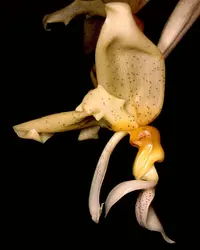
This orchid produces its large, fragrant flowers on downward-facing spikes that emerge through or below the basket or substrate, which is why it is usually grown in hanging containers with very open sides.

Intense nocturnal fragrance

The flowers release a very strong, sweet and spicy scent mainly during the night and early morning, an adaptation that helps attract specific nocturnal pollinators in its native habitats of Mexico and Central America.

Short-lived but spectacular blooms

Individual flowers of this species typically last only a few days, but they appear in groups on a single inflorescence, creating a brief yet very showy flowering event that many growers time and anticipate carefully when learning Stanhopea graveolens care instructions.

Botan icon

Did you know?

In the wild, Stanhopea graveolens often grows as an epiphyte on mossy tree branches in humid mountain forests, where its pendant flower spikes can hang freely into the air below the host branch, a growth habit that strongly influences how orchid specialists design its cultivation setups in collections.

FAQs about Stanhopea graveolens

This species usually blooms in summer to early fall, producing pendant flower spikes that emerge through the basket or pot. The large, fragrant flowers are short-lived, often lasting only a few days but appearing on mature plants each year.

Grow Healthy Plants with Botan Care

Keep your plants happy and healthy with plant identification, disease detection, and easy care guidance.

Botan plant care app — identify plants on mobile

Explore More Plants