Install sturdy staking
Place 1–3 robust stakes or a low wire frame around clumps in early spring, then loosely tie stems as they elongate to prevent wind or storm damage to tall, top-heavy growth.

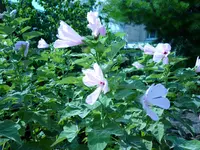
Swamp rosemallow (Hibiscus grandiflorus) is a robust, long-lived perennial shrub native to wetlands and marsh edges in the southeastern United States. It thrives in consistently moist to wet conditions and often grows in standing water.
Plants form tall, upright clumps with large, soft leaves and very showy, wide hibiscus flowers in pale pink to rose tones, usually with a deeper center. The blooms attract bees, butterflies, and hummingbirds.
This species is generally straightforward to grow if its need for ample moisture and sun is met, but it struggles in dry soils. Understanding how to care for swamp rosemallow starts with providing wet, rich soil and plenty of light.

Care Difficulty
Moderate Care

Light Preference
Full Sun

Water Requirements
Aquatic

Temperature Preference
Warm Climate

Hardiness Zone
8–11

Soil Texture
Sandy, Loamy, Organic-rich

Soil pH
Acidic (5.5–6.5), Slightly acidic (6.5–7.0)

Soil Drainage
Waterlogged tolerant

Fertilization
Light (every 4–6 weeks)
Scan your plant to receive care tips personalized for your specific plant
Available on iOS and Android
Hibiscus grandiflorus thrives in bright, warm conditions with plenty of direct sun.
This wetland hibiscus prefers consistently moist conditions and does not like to dry out fully.
This species grows best in warm, humid climates and has limited cold tolerance.
Hibiscus grandiflorus prefers consistently moist air but adapts to typical outdoor humidity in most warm regions.
Hibiscus grandiflorus thrives in consistently moist, organic-rich soil that stays wet longer than typical garden beds without becoming stagnant.
This species can be grown in large containers when water and stability are carefully managed.
Hibiscus grandiflorus benefits from steady but modest nutrition during the warm growing season.
Hibiscus grandiflorus responds well to light, structured pruning that maintains shape and flowering wood.
This species is most often grown in the ground, so focus on careful transplanting rather than frequent repotting.
Hibiscus grandiflorus is commonly propagated by softwood cuttings and seeds under warm, bright conditions.
This swamp-adapted hibiscus is only moderately hardy and needs attention in regions with freezing winters.

Plant Health Check
Not sure what's wrong with your plant? Check your plant's health inside the app.
This species is naturally restricted to freshwater and slightly brackish marshes, ditches, and pond margins along the southeastern US Gulf and Atlantic Coastal Plain, where it grows in saturated or shallowly flooded soils.
It bears some of the largest native hibiscus flowers in North America, typically 10–15 cm across, with soft pink to pale lavender petals and a contrasting darker center that help guide pollinators.
In its native range, the flowers are frequently visited by large bees such as bumble bees and carpenter bees, which become dusted with pollen as they crawl over the central column of fused stamens and style.

Genetic and morphological studies suggest that this species is closely related to other swamp mallows like Hibiscus moscheutos and has likely hybridized with them in the wild, which can make field identification challenging where their ranges overlap.
Lack of blooms often results from plants being too young, insufficient nutrients, or stress from past drought or transplanting. Ensure adequate maturity, avoid heavy pruning in spring, and maintain consistent moisture and balanced fertilization to support flowering.
Keep your plants happy and healthy with plant identification, disease detection, and easy care guidance.