Leaf litter mulching
Allow a 5–8 cm layer of fallen leaves to remain under the shrub each autumn, as this mimics its woodland habitat, moderates soil temperature, and slowly improves soil structure.

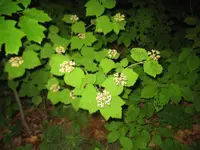
Mapleleaf viburnum, Viburnum acerifolium, is a deciduous shrub native to woodlands of eastern North America. It typically grows in the understory, forming loose, multi-stemmed clumps.
The plant has maple-like leaves that turn soft pink, red, or purple in fall, and flat clusters of white flowers followed by dark berries. Its moderate growth rate, tolerance of shade, and adaptability to different garden soils make it relatively straightforward to care for mapleleaf viburnum.
This shrub prefers partial shade, consistent moisture, and well-drained, humus-rich soil, similar to woodland conditions.

Care Difficulty
Easy Care

Light Preference
Partial Shade

Water Requirements
Moderate Water

Temperature Preference
Cold Hardy

Hardiness Zone
4–8

Soil Texture
Loamy, Silty, Organic-rich

Soil pH
Acidic (5.5–6.5), Slightly acidic (6.5–7.0)

Soil Drainage
Moist but well-drained

Fertilization
Minimal (feed rarely)
Scan your plant to receive care tips personalized for your specific plant
Available on iOS and Android
This understory shrub prefers dappled woodland light but adapts to a range of outdoor exposures.
This shrub prefers consistently moist, well-drained soil rather than strict watering schedules.
This hardy deciduous shrub is adapted to temperate climates with cold winters and warm summers.
This shrub handles a broad humidity range and usually does not need special humidity management outdoors.
This woodland shrub prefers loose, humus-rich soil that holds moisture but still drains freely.
This species can be grown in containers, though it performs best long term in the ground.
In average garden soil, mapleleaf viburnum needs only modest feeding to maintain healthy growth.
Pruning Viburnum acerifolium is mainly done to maintain structure and remove problem wood, not to control size aggressively.
This species is usually grown in the ground, so focus on transplanting rather than routine repotting.
Viburnum acerifolium is commonly propagated by softwood cuttings or seeds, with layering also possible.
This shrub is cold hardy in much of its range and usually needs minimal winter care once established.

Plant Health Check
Not sure what's wrong with your plant? Check your plant's health inside the app.
This species is naturally adapted to grow in the understory of eastern North American deciduous forests, often thriving in relatively deep shade where many other shrubs decline.
Its leaves are palmately lobed and strongly resemble those of small maples, which is unusual among viburnums and is the origin of its common name, mapleleaf viburnum.
In autumn, its foliage often turns soft pink to wine-red or purplish tones, contributing significantly to the layered fall color display in many eastern hardwood forests.

This species plays an important wildlife role by providing late-summer to fall fruit for birds such as thrushes and cardinals, while also offering nectar and pollen for native bees and other insects when it flowers earlier in the season.
This shrub provides nectar and pollen for many native bees and small butterflies. Its flat white flower clusters are easy for insects to land on, so it supports pollinators and can improve overall garden biodiversity.
Keep your plants happy and healthy with plant identification, disease detection, and easy care guidance.