Clump Division Timing
Divide congested clumps every 3–5 years in early spring before strong new growth, replanting outer, more vigorous sections to maintain flowering performance and overall vigor when growing St. Bernard’s lily.

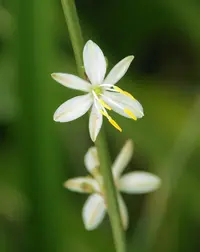
St. Bernard’s lily, Anthericum liliago, is a clump-forming perennial with narrow, grass-like leaves and airy stems topped with white star-shaped flowers. It has a light, graceful look that suits informal borders and naturalistic plantings.
This species is native to parts of central and southern Europe, where it grows in sunny, well-drained meadows and rocky slopes. Its hardy nature and tolerance of relatively poor soils make it a moderate, low-fuss choice once established.
Plants prefer good light, free-draining soil, and even moisture during active growth, but dislike heavy, waterlogged ground. These traits make it fairly straightforward to care for St. Bernard’s lily in many garden settings.

Care Difficulty
Easy Care

Light Preference
Full Sun

Water Requirements
Moderate Water

Temperature Preference
Cold Hardy

Hardiness Zone
4–9

Soil Texture
Sandy, Loamy, Organic-rich

Soil pH
Acidic (5.5–6.5), Slightly acidic (6.5–7.0)

Soil Drainage
Well-drained

Fertilization
Minimal (feed rarely)
Scan your plant to receive care tips personalized for your specific plant
Available on iOS and Android
Anthericum liliago grows best in bright, open positions with gentle protection from harsh afternoon sun.
Anthericum liliago prefers evenly moist, free-draining soil rather than constant wetness.
This species is a hardy perennial that tolerates cool winters and mild to warm summers when planted in the ground.
This species handles typical indoor humidity but benefits from moderately moist air.
This species prefers loose, well-drained, moderately fertile ground.
This species grows reliably in containers outdoors when drainage is carefully managed.
This hardy perennial needs modest feeding to flower well, especially in poorer soils.
Anthericum liliago benefits from light, targeted pruning to keep clumps tidy and flowering well.
This plant is more often grown in the ground, but container specimens and crowded clumps still need occasional attention.
This species is most commonly multiplied by division, with seed used where large numbers are needed.
This hardy perennial usually tolerates typical temperate winters with minimal intervention once established.

Plant Health Check
Not sure what's wrong with your plant? Check your plant's health inside the app.
This species is naturally native to dry, rocky grasslands and open woodlands of central and southern Europe, where it often grows on calcareous, lime-rich soils rather than in typical woodland loam.
Its flowering stems carry multiple star-shaped white flowers in a loose panicle, with each individual flower opening for a short time but the whole inflorescence extending the display over several weeks in late spring to early summer.
The plant spreads slowly via short rhizomes, forming long-lived, stable clumps that can persist for many years in the same site without becoming aggressively invasive.

In some traditional European cottage gardens, this species was historically planted near paths and house entrances because its upright stems and bright white, lightly fragrant flowers were valued as a modest, long-lived ornamental that would return reliably each late spring with minimal intervention.
This species slowly forms clumps by short rhizomes and gentle self-seeding. It is not considered aggressive or invasive in typical garden conditions. Unwanted seedlings are easy to pull, and clumps can be divided to control size.
Keep your plants happy and healthy with plant identification, disease detection, and easy care guidance.