Provide climbing support
Install a sturdy moss pole or rough wooden stake and loosely tie the stems so the plant can climb, which encourages larger, healthier leaves and a more stable structure over time.

Anthurium pentaphyllum is a tropical aroid grown mainly for its unusual, deeply divided leaves and climbing habit. It often develops a vining, architectural look on a support. Native to Central and South America, it grows as an understory plant in warm, humid forests, where it receives filtered light and consistent moisture. Its growth is moderate and generally steady when conditions are stable. This species is considered moderately demanding, mainly due to its need for higher humidity and airy, well-drained substrate. Once those needs are met, how to care for Anthurium pentaphyllum becomes more predictable, making it suitable for patient indoor growers who already handle other tropical foliage plants.

Care Difficulty
Moderate Care

Light Preference
Bright Indirect Light

Water Requirements
Moderate Water

Temperature Preference
Tropical / Frost Sensitive

Hardiness Zone
11–12

Soil Texture
Loamy, Peaty, Organic-rich

Soil pH
Acidic (5.5–6.5), Slightly acidic (6.5–7.0)

Soil Drainage
Moist but well-drained

Fertilization
Light (every 4–6 weeks)
Scan your plant to receive care tips personalized for your specific plant
Available on iOS and Android
This species prefers bright, filtered light similar to a forest understory.
Watering should keep the root zone lightly moist but never saturated.
Temperature should remain warm and stable to support healthy growth and root function.
This species benefits from consistently high humidity for best foliage and root health.
This species prefers a loose, airy, organic-rich mix that drains quickly yet retains moderate moisture.
This species grows very well in containers when the pot supports its climbing, spreading root system.
This species benefits from light, consistent feeding during active growth for balanced foliage and root development.
Pruning is mainly used to maintain plant health and a tidy shape rather than to control size drastically.
Container-grown plants appreciate periodic repotting to refresh the medium and give roots space to expand.
Most home growers propagate this species by division or stem cuttings taken from mature, healthy plants.
As a tropical species, this plant is not frost tolerant and needs mild, stable conditions in winter.

Plant Health Check
Not sure what's wrong with your plant? Check your plant's health inside the app.
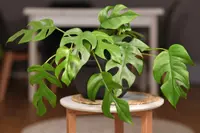
This species naturally grows as a climbing aroid with long, flexible stems that scramble over trees, giving it a palm-like appearance when the leaves are fully divided.
Mature plants develop leaves that split into 5 or more narrow leaflets from a single stalk, a trait reflected in the name pentaphyllum, which refers to five leaf segments.
Juvenile plants often have simple or only shallowly lobed leaves, and the characteristic deeply divided leaf form appears only as the plant matures and receives adequate support to climb.
This species is a scandent aroid, meaning it climbs rather than forming a bush or ground cover. It produces long, vining stems that attach to rough surfaces or supports using aerial roots as it matures.
Keep your plants happy and healthy with plant identification, disease detection, and easy care guidance.