Safe handling routine
Always wear gloves and avoid touching your face or eyes when repotting or taking cuttings, then wash tools and hands afterward to prevent irritation from the toxic latex sap.

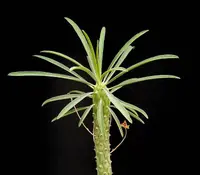
Club Noors, botanically known as Euphorbia clava, is a small, shrubby succulent from arid regions of South Africa. It forms thick, club-shaped green stems with few or no leaves. New growth appears from the stem tips, creating a compact clump that slowly enlarges over time. Small, understated flowers emerge near the stem ends. As a drought-adapted plant, it stores water in its stems and is sensitive to overwatering. It prefers bright light, very free-draining soil, and careful watering, which makes it better suited to growers who already understand basic succulent care. With the right setup, it is relatively straightforward to care for Club Noors.

Care Difficulty
Moderate Care

Light Preference
Full Sun

Water Requirements
Low Water

Temperature Preference
Tropical / Frost Sensitive

Hardiness Zone
10–11

Soil Texture
Sandy, Loamy, Rocky

Soil pH
Slightly acidic (6.5–7.0), Neutral (7.0)

Soil Drainage
Well-drained

Fertilization
Minimal (feed rarely)
Scan your plant to receive care tips personalized for your specific plant
Available on iOS and Android
This succulent prefers bright, indirect light with some direct morning sun for compact, healthy growth.
Water this species sparingly, allowing the soil to dry well between waterings to prevent root rot.
This succulent prefers warm, dry conditions and does poorly in cold or freezing weather.
This species handles typical indoor humidity well and rarely needs special humidity management.
This succulent requires a very fast-draining, mineral-based mix that prevents water from sitting around the roots.
This species is well suited to container growing when root zone moisture is tightly controlled.
Euphorbia clava benefits from light, controlled feeding during active growth in spring and summer.
Pruning Euphorbia clava is mainly for health, safety, and slight shape control rather than size reduction.
Container-grown Euphorbia clava prefers infrequent repotting in a gritty, fast-draining mix.
Propagation of Euphorbia clava is usually done by stem cuttings under warm, bright, and dry-leaning conditions.
Euphorbia clava is not frost tolerant and needs a dry, above-freezing environment in winter.

Plant Health Check
Not sure what's wrong with your plant? Check your plant's health inside the app.
This species is naturally restricted to parts of South Africa, where it grows in arid, rocky habitats and low scrub, often on well-drained sandstone or granite slopes.
The plant forms thick, club-like succulent stems with small, scattered tubercles, an adaptation that allows water storage while reducing exposed surface area and water loss in its dry native range.
Like many spurges, it produces a white, milky latex that is chemically irritant, deterring most herbivores and requiring careful handling to avoid skin and eye irritation.

In habitat, this species often grows partially shaded by surrounding scrub vegetation, using neighboring plants as a microhabitat buffer that reduces temperature extremes and water stress while still providing enough light for photosynthesis.
This species grows slowly, usually adding only a few centimeters in height each year. Growth is most active in warmer months, then pauses in cooler seasons. Limited root space and low light further reduce its already modest growth rate.
Keep your plants happy and healthy with plant identification, disease detection, and easy care guidance.