Support on Slopes
On sloping or rocky sites, plant in small staggered groups and use a few flat stones on the downhill side of each clump to stabilize soil and reduce erosion around the crown.

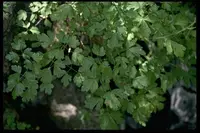
Van Houtte's columbine (Aquilegia eximia) is a perennial wildflower native to rocky slopes and coastal mountains of central California. It belongs to the buttercup family, Ranunculaceae. The plant forms clumps of divided, blue‑green leaves and sends up upright stems topped with nodding red and yellow flowers. The blooms have short spurs and a slightly wild, informal look. Aquilegia eximia tends to be relatively short lived but often reseeds in suitable conditions, creating a naturalized patch over time. It is considered moderately easy to grow when given conditions similar to its native habitat. To care for Van Houtte's columbine, provide well‑drained soil, moderate moisture, and light ranging from bright dappled shade to gentle morning sun.

Care Difficulty
Moderate Care

Light Preference
Partial Shade

Water Requirements
Moderate Water

Temperature Preference
Cool Climate

Hardiness Zone
7–9

Soil Texture
Loamy, Sandy, Organic-rich

Soil pH
Acidic (5.5–6.5), Slightly acidic (6.5–7.0)

Soil Drainage
Moist but well-drained

Fertilization
Minimal (feed rarely)
Scan your plant to receive care tips personalized for your specific plant
Available on iOS and Android
Aquilegia eximia prefers cool, bright conditions with protection from intense midday sun.
Aquilegia eximia prefers evenly moist, well-drained soil that never stays saturated for long.
This species grows best in cool to mild conditions rather than intense heat.
This species tolerates a wide humidity range and usually does not need special humidity management outdoors.
Aquilegia eximia prefers cool, moist, well‑structured soil that drains freely yet does not dry out quickly.
This species can be grown in containers, but pots must be managed to stay cool and evenly moist without becoming waterlogged.
Aquilegia eximia grows well in reasonably fertile soil and only needs light feeding during the active season.
Pruning Aquilegia eximia focuses on grooming and encouraging repeat or stronger flowering.
This species is usually grown in the ground, so transplanting Aquilegia eximia is more common than repotting.
Aquilegia eximia is most often propagated by seed, with division used occasionally for established clumps.
Aquilegia eximia is generally cold hardy and needs only modest winter care in most temperate gardens.

Plant Health Check
Not sure what's wrong with your plant? Check your plant's health inside the app.
This species is naturally restricted to a small stretch of the Central California coast ranges, where it grows in rocky chaparral and coastal scrub rather than in the moist woodland habitats typical of many other columbines.
Its strongly red, lantern-shaped flowers with short backward-pointing spurs are adapted to hummingbird pollination, contrasting with the longer-spurred, often bicolored flowers of many related columbine species.
Compared to many Aquilegia species that prefer cooler, partially shaded sites, this plant tolerates more sun and drier, warmer conditions typical of its native chaparral slopes, which is useful to understand when planning Aquilegia eximia care.

Aquilegia eximia is considered rare in the wild and is included in regional conservation discussions because of its limited distribution in California’s coastal mountains and ongoing habitat pressures from development and land-use change.
This species is highly attractive to hummingbirds, native bees, and some butterflies, mainly due to its red, tubular flowers and nectar production. It can play a useful role in supporting local pollinator populations in woodland or meadow-style gardens.
Keep your plants happy and healthy with plant identification, disease detection, and easy care guidance.