Host root selection
Establish plants by sowing or transplanting near vigorous, deep-rooted host species such as tamarisk or salt-tolerant shrubs, since this holoparasite requires direct attachment to host roots to survive and flower.

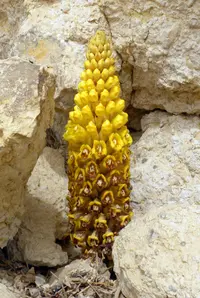
Desert hyacinth (Cistanche tubulosa) is a leafless, parasitic flowering plant that grows from a thick, fleshy spike emerging directly from the ground. It produces dense clusters of yellow to orange tubular flowers, giving it a striking appearance in otherwise bare, sandy or rocky habitats.
This species is native to arid and semi-arid regions of North Africa, the Middle East, and parts of Asia, where it attaches to the roots of host plants for water and nutrients. Because it depends on suitable host species and very dry, well-drained conditions, it can be challenging to cultivate.
Gardeners who want to care for Desert hyacinth need to understand its parasitic lifestyle and preference for intense light and minimal moisture.

Care Difficulty
Hard Care

Light Preference
Full Sun

Water Requirements
Low Water

Temperature Preference
Tropical / Frost Sensitive

Hardiness Zone
10–11

Soil Texture
Sandy, Rocky

Soil pH
Neutral (7.0), Slightly alkaline (7.0–7.5)

Soil Drainage
Well-drained

Fertilization
Minimal (feed rarely)
Scan your plant to receive care tips personalized for your specific plant
Available on iOS and Android
Cistanche tubulosa thrives in bright, open desert-like conditions with strong sun exposure.
This desert parasite requires very sparse watering and is highly sensitive to excess moisture around its host and root zone.
This species is adapted to hot, arid climates and performs best in consistently warm conditions.
Humidity is not a significant factor for Cistanche tubulosa, which is strongly adapted to arid conditions.
Cistanche tubulosa requires very dry, sandy, and sharply draining substrate that mimics desert soils.
This species is generally unsuitable for long-term container growing because it is an obligate root parasite that depends on a host plant in open ground.
Cistanche tubulosa is a desert parasitic plant that generally needs minimal direct fertilization when grown in the ground.
Pruning Cistanche tubulosa is minimal and mainly focused on hygiene and seed management rather than shaping.
This species is rarely kept as a typical potted plant because it is an obligate root parasite on desert shrubs.
Propagation of Cistanche tubulosa is technically demanding because it requires compatible host roots to survive.
Winter care needs depend strongly on climate and the hardiness of both Cistanche tubulosa and its host plants.

Plant Health Check
Not sure what's wrong with your plant? Check your plant's health inside the app.
This species is a holoparasite that completely lacks chlorophyll and must attach its haustoria to desert shrubs such as Haloxylon or Tamarix roots to obtain water and nutrients.
It produces dense, club-shaped flower spikes that can reach over 30 cm tall, emerging directly from the sand in early spring after cool-season rainfall.
In the wild it commonly grows in saline and sandy soils of arid regions from North Africa to northwestern China, where it is adapted to high light, low rainfall, and strong evaporation.

This species is considered a keystone component of some desert ecosystems because its large, nutrient-rich flowering spikes and tissues provide food for insects, grazing animals, and decomposers in otherwise resource-poor habitats.
This species needs a suitable host root, several months of cool-season growth, and full sun to form a flower spike. Lack of a compatible host, excessive disturbance, or too-warm winter conditions often prevent flowering.
Keep your plants happy and healthy with plant identification, disease detection, and easy care guidance.