pineland dwarf mistletoe Care (Arceuthobium vaginatum)

Also known as: Southwestern Dwarf-Mistletoe
pineland dwarf mistletoe

About pineland dwarf mistletoe

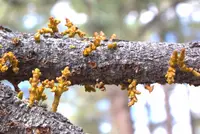
Pineland dwarf mistletoe, Arceuthobium vaginatum, is a tiny parasitic flowering plant that lives on the branches of pine trees, especially in dry, open forests. It forms dense, broom-like growths on its host, with short, leafless shoots that are easy to overlook from a distance but obvious up close.

This species is native to western North American pine woodlands and depends entirely on host trees for water and nutrients. Because it is an obligate parasite and difficult to establish without suitable pines, it is not a practical choice for typical home cultivation, and guides on how to care for pineland dwarf mistletoe are aimed mainly at forestry and ecological management rather than hobby growing.

Main Plant Requirements

Care Difficulty

Hard Care

Light Preference

Full Sun

Water Requirements

Low Water

Temperature Preference

Cold Hardy

Hardiness Zone

4–8

Soil Texture

Sandy, Loamy, Rocky

Soil pH

Acidic (5.5–6.5)

Soil Drainage

Well-drained

Fertilization

Minimal (feed rarely)

Get Personalized Care Plan

Scan your plant to receive care tips personalized for your specific plant

Available on iOS and Android

How to Care for the pineland dwarf mistletoe

This parasitic conifer mistletoe depends on host exposure, so its light needs follow the pine or other conifer it inhabits.

  • Thrives on hosts in full sun to bright, open woodland light, typically receiving 6–10 hours of direct or high-intensity light on exposed branches.
  • Tolerates partial shade where host pines grow under taller trees, but heavy shade reduces shoot density and fruiting of pineland dwarf mistletoe.
  • Excessive, exposed afternoon sun in very hot, dry sites can increase host-branch stress and dieback, indirectly limiting mistletoe vigor over time.

This hemiparasitic plant draws most of its water from the host tree’s vascular system rather than from soil around its own shoots.

  • Best performance occurs when the host conifer grows in well-drained, slightly dry to moderate soil; prolonged waterlogged conditions promote root rot in the host, which weakens mistletoe stands.
  • Drought signs appear first in the host (thinning needles, tip dieback) rather than in Arceuthobium vaginatum shoots, which often remain green until host decline is advanced.
  • In field management, observe native rainfall; avoid supplementary irrigation that keeps soil constantly saturated, especially around compacted or poorly drained planting sites.

This species is adapted to cool to warm temperate and montane climates on pine hosts.

  • Optimal activity occurs where seasonal temperatures range roughly 40–80°F (4–27°C), matching the growth envelope of many pine hosts.
  • Can tolerate winter lows down to about 0°F (−18°C) on hardy conifers, but repeated freezes below this increase host twig mortality and can reduce infection intensity.
  • Handles summer highs near 90–95°F (32–35°C) if the host is not drought-stressed, but extended heat above this with dry winds accelerates host branch dieback and shrivelled shoots.

Humidity is not a meaningful care factor because this species is a parasitic mistletoe living on pine hosts in open, dry habitats.

This parasitic species does not grow in conventional soil and instead depends on its pine host’s tissues for water and nutrients.

  • Do not attempt to plant Arceuthobium vaginatum in pots or beds, since it requires direct contact with living pine branches and bark.
  • In natural settings it occurs on well-drained, often sandy or rocky mineral soils that support its pine hosts, rather than for its own root system.
  • Management focuses on maintaining healthy host trees in aerated, non-waterlogged ground, as saturated or compacted soil stresses the host and indirectly harms the mistletoe.
  • Avoid adding dense, high-clay topdressings around host pines that could impede drainage and reduce oxygen around fine feeder roots.

This parasitic mistletoe is not suitable for container growing because it must live attached to living pine hosts, not in potting media.

Arceuthobium vaginatum is a parasitic mistletoe on pines and does not benefit from direct fertilization, so focus on host tree nutrition instead.

Pruning Arceuthobium vaginatum is done to reduce parasite load and protect the host pine, not to shape the mistletoe.

  • Carry out pruning in late winter or very early spring, before active sap flow and bird dispersal peak.
  • Remove infected twigs or small branches at least 15–30 cm below visible mistletoe shoots to reduce regrowth.
  • Use clean, sharp bypass pruners or a pruning saw; disinfect blades between trees to limit pathogen spread.
  • Limit cuts to maintain host canopy strength and reduce stress on already weakened trees.

Transplanting focuses on the host pine rather than the pineland dwarf mistletoe itself, which cannot be moved independently.

  • Consider transplanting only when young pines show severe decline or when shifting to a less infested area.
  • Plan moves during cool, dormant seasons, typically late fall or very early spring, to limit transplant shock.
  • Water host roots thoroughly before and after moving, and shade temporarily to reduce transpiration stress.
  • Monitor for new mistletoe infections on the transplanted host and remove nearby heavily infested source trees if feasible.

Intentional propagation of Arceuthobium vaginatum is rarely appropriate, as this species is a parasitic forest pathogen with significant host impacts.

This mistletoe and its pine hosts are generally cold hardy in their native range and need no special winter protection.

Care Tips

Host selection

When establishing research or conservation plots, prioritize naturally regenerating or planted pine hosts known to tolerate infection rather than trying to maintain this parasitic species on stressed or declining trees.

Infection monitoring

Mark and map infected branches on host pines and re-check them annually so disease progression, cone production, and host decline can be tracked over time in a consistent way.

Branch sanitation

For long-term host health, selectively remove heavily infected small branches during dormant seasons, cutting at least 30–40 cm back from visible shoots to reduce mistletoe tissue embedded in the wood.

Cone and seed control

If limiting spread is a goal, prune and destroy branches bearing mature mistletoe cones before seed discharge, as the seeds are explosively ejected and readily infect nearby branches.

Wind and spacing management

When managing stands that include this species, maintain wider spacing between susceptible host trees and orient new plantings to reduce downwind spread from heavily infected individuals, which is central to caring for pineland dwarf mistletoe in forestry settings.

Common Pests and Diseases

Dwarf mistletoe witches’ brooms

Symptoms include dense, brush-like clusters of distorted pine shoots that form around infection sites on host branches. This disease alters normal branch growth and weakens the host tree over time.

Solution

Prune out witches’ brooms by removing the entire infected branch at least 30–45 cm back from visible swelling, ideally during dry weather to reduce pathogen spread. In managed forests or landscapes, combine sanitation pruning with removal of heavily infested host trees to reduce inoculum and follow regional Arceuthobium vaginatum care instructions for spacing and stand thinning.

Stem cankers

This disease causes swollen, cracked, or sunken lesions on infected host branches and stems where the parasite emerges. Over time, the canker can girdle the branch, leading to dieback beyond the infection point.

Solution

Cut out affected branches well below the cankered area, making clean cuts that leave no visible swelling or discoloration. Dispose of removed material away from the stand and avoid leaving cut, infected branches on site where they can continue to release seed.

Host branch dieback

Symptoms include progressive yellowing, thinning foliage, and eventual death of individual branches on the host pine as the parasite diverts water and nutrients. This condition reduces overall crown density and can predispose the tree to other stresses.

Solution

Remove dead and severely declining branches promptly to limit seed production and reduce stress on the remaining crown. Improve overall host vigor through appropriate thinning, avoiding soil compaction, and maintaining species mixes that are less susceptible to heavy parasitic loads.

Secondary bark beetle attack

These insects often colonize weakened, heavily parasitized host pines, creating small entry holes, boring dust, and patches of discolored bark. Tree decline can accelerate rapidly once beetle populations build up in stressed hosts.

Solution

Monitor parasitized pines for early signs of bark beetle activity and remove or fell heavily infested trees to break the beetle life cycle. Maintain stand health through density management and species diversity so that host trees are less attractive to beetles triggered by mistletoe stress.

Interesting Facts

Specialized pine parasite

This species parasitizes specific pines such as ponderosa pine and lodgepole pine, invading the host’s xylem tissue and diverting water and nutrients directly from the tree.

Reduced leafy structure

Instead of normal leaves, it has highly reduced, scale‑like structures and most of its biomass remains embedded inside host branches, a typical adaptation of dwarf mistletoes to a parasitic lifestyle.

Fire-influenced distribution

Populations often track fire history in western North American forests, because fire can limit severe infections by killing heavily infested branches and stands while leaving lightly infested or uninfected areas as seed sources.

Botan icon

Did you know?

Seed dispersal in this species relies on small, explosive fruits that build up internal pressure and then shoot sticky seeds several meters away, allowing new infections on nearby pine branches high in the canopy.

FAQs about pineland dwarf mistletoe

This species spreads very aggressively on suitable conifer hosts. Seeds are explosively discharged and stick to nearby branches, where new infections establish. In forests it can form dense, damaging infestations if not monitored and managed.

Grow Healthy Plants with Botan Care

Keep your plants happy and healthy with plant identification, disease detection, and easy care guidance.

Botan plant care app — identify plants on mobile

Explore More Plants