Mounting strategy
Mount plants on cork or hardwood with a thin pad of long-fiber sphagnum and position them slightly tilted so new growths have space to extend and create a spreading mat rather than crowding each other.

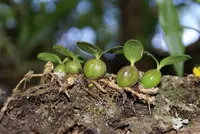
Bulbophyllum nutans is a small, epiphytic orchid that typically grows on tree trunks and branches rather than in soil. It forms compact clumps with slender, upright pseudobulbs and a single leaf on each, giving it a tidy, architectural look.
This species is native to parts of tropical Africa, where it experiences warm temperatures, high humidity, and good air movement. Its nodding flower spikes carry small, often subtly colored blooms that appeal to collectors of unusual orchids.
Bulbophyllum nutans can be moderately challenging, as it dislikes drying out completely and is sensitive to stale, stagnant conditions. Understanding how to care for Bulbophyllum nutans usually involves providing bright shade, frequent light watering, and a very airy growing medium or mount.

Care Difficulty
Hard Care

Light Preference
Bright Indirect Light

Water Requirements
Keep Soil Moist

Temperature Preference
Tropical / Frost Sensitive

Hardiness Zone
11–13

Soil Texture
Peaty, Organic-rich, Sandy

Soil pH
Acidic (5.5–6.5)

Soil Drainage
Moist but well-drained

Fertilization
Light (every 4–6 weeks)
Scan your plant to receive care tips personalized for your specific plant
Available on iOS and Android
This orchid prefers bright, filtered light that mimics its forest habitat.
This species prefers evenly moist conditions without staying waterlogged.
This orchid performs best in consistently warm, stable temperatures.
This species needs consistently high humidity to thrive in cultivation.
Bulbophyllum nutans prefers a very airy, fast-draining epiphytic medium rather than conventional potting soil.
This orchid is well suited to container or basket growing when its spreading growth habit is considered.
This orchid benefits from light, consistent feeding during active growth for steady foliage and root development.
Pruning focuses on hygiene rather than shaping, keeping this orchid healthy and flowering reliably.
This species prefers a stable root environment and should be disturbed only when clearly necessary.
Propagation is usually done by division, as seed growing requires sterile laboratory conditions.
This orchid is not frost hardy and must be kept in mild, protected conditions through winter.

Plant Health Check
Not sure what's wrong with your plant? Check your plant's health inside the app.
This species forms dense, creeping mats of very small pseudobulbs, each carrying a single narrow leaf, which allows it to cover bark surfaces efficiently and share water and nutrient resources along the rhizome network.
Its specific epithet nutans refers to the nodding position of the small flowers, which hang down on slender, wiry stalks rather than facing outward or upward.
In nature it grows as an epiphyte on tree trunks and branches in humid forests, anchoring to bark with a fine root system and relying on rain, mist, and leaf litter debris rather than true soil.
This orchid does best in controlled indoor or greenhouse conditions where warmth, humidity, and air movement stay stable. Outdoor growing is only suitable in frost-free, very humid climates with sheltered, shaded positions and careful mounting or basket culture.
Keep your plants happy and healthy with plant identification, disease detection, and easy care guidance.