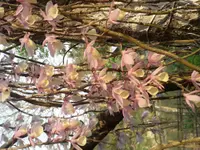
Lobb's bulbophyllum Care (Bulbophyllum lobbii)

Also known as: Thailand bulbophyllum, Sumatran bulbophyllum
Lobb's bulbophyllum

About Lobb's bulbophyllum

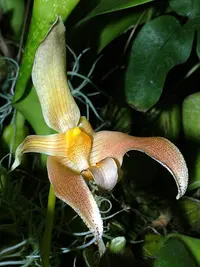
Lobb's bulbophyllum (Bulbophyllum lobbii) is a compact epiphytic orchid that grows on trees, forming small clumps of pseudobulbs and thick roots. It produces large, showy flowers with distinctive, often twisting petals and a mobile lip, giving it a striking, unusual look for its size.

This species is native to warm, humid forests of Southeast Asia, where it grows in shaded, airy tree canopies. Its preference for consistent moisture, high humidity, and good air movement makes it moderately challenging for beginners. Understanding how to care for Lobb's bulbophyllum starts with providing gentle, filtered light and a loose, fast-draining orchid medium.

Main Plant Requirements

Care Difficulty

Hard Care

Light Preference

Bright Indirect Light

Water Requirements

Keep Soil Moist

Temperature Preference

Tropical / Frost Sensitive

Hardiness Zone

Unknown

Soil Texture

Peaty, Organic-rich, Sandy

Soil pH

Acidic (5.5–6.5)

Soil Drainage

Moist but well-drained

Fertilization

Moderate (every 2–4 weeks)

Get Personalized Care Plan

Scan your plant to receive care tips personalized for your specific plant

Available on iOS and Android

How to Care for the Lobb's bulbophyllum

This orchid prefers bright, filtered light that mimics dappled forest conditions.

  • Provide 8–12 hours of bright, indirect light daily, such as under 30–50% shade cloth or behind sheer curtains if grown under cover.
  • Allow soft morning sun but protect Lobb's bulbophyllum from strong midday and afternoon sun, which can scorch leaves and cause yellow patches.
  • In winter, move the plant to the brightest sheltered spot available; if leaves darken and growth slows, increase light, but if they redden, slightly reduce exposure.

This species prefers evenly moist conditions without prolonged saturation around the roots.

  • Water when the surface and upper 1–2 cm of the medium feel just barely dry, using thorough soakings that drain completely each time.
  • Use a very free-draining orchid mix; persistent wetness, sour smell, or black, mushy pseudobulbs indicate overwatering and poor aeration.
  • In warmer months, watering may be needed several times per week, while in cooler seasons allow a slightly longer interval, watching for wrinkled pseudobulbs as a sign of underwatering.

This orchid grows best in warm to intermediate conditions with minimal temperature extremes.

  • Aim for 65–80°F (18–27°C) by day and 60–70°F (16–21°C) at night to support steady Bulbophyllum lobbii growth.
  • Protect the plant from temperatures below 55°F (13°C); brief dips to 50°F (10°C) may be tolerated, but frost will severely damage or kill it.
  • In hot weather above 85°F (29°C), increase air movement and humidity and shade more strongly to prevent heat stress, leaf scorch, and stalled flowering.

This orchid prefers consistently high humidity to maintain healthy roots and pseudobulbs.

  • Aim for 60–80% humidity, using a hygrometer to avoid prolonged periods below 50%.
  • Dry air causes wrinkled pseudobulbs, dull leaves, and stalled new growth in Lobb's bulbophyllum.
  • Increase humidity with a room humidifier, grouped plants, or a pebble tray, while keeping air movement gentle but constant.

Bulbophyllum lobbii grows best in a very loose, airy, organic medium rather than traditional potting soil.

  • Use a chunky orchid mix: medium bark, sphagnum moss, and a little perlite or charcoal to keep structure open.
  • Ensure rapid drainage; water should run through in seconds and the mix should never stay waterlogged.
  • Aim for slightly acidic to neutral conditions (pH 5.5–7.0), which support nutrient uptake and root health.
  • Avoid fine, compact, or peat-heavy media that pack tightly and suffocate roots; refresh mix if it starts to break down.

This species is well suited to container culture when the pot and setup support its epiphytic root system.

  • Choose a shallow, wide orchid pot or basket that matches its creeping rhizomes and prevents cramped growth.
  • Select slotted plastic or wooden baskets to increase side airflow and speed up drying after watering.
  • Secure the container in a stable outer cachepot or on a bench to prevent tipping from lateral pseudobulb growth.

This orchid benefits from light, consistent feeding during its active growth.

  • Use a balanced NPK orchid fertilizer at 1⁄4–1⁄2 strength every 2–3 weeks in spring and summer.
  • Apply only to moist medium to avoid root burn in Lobb's bulbophyllum.
  • Reduce feeding to once a month or stop entirely in fall and winter when growth slows.
  • Avoid compost or heavy slow-release products that can break down the airy orchid mix.

Bulbophyllum lobbii needs minimal pruning, focused on hygiene rather than shaping.

  • Best time is after flowering or during active growth so the plant recovers quickly.
  • Remove dead, yellow, or damaged leaves and spent flower spikes with sterile scissors.
  • Thin only clearly overcrowded or rotting pseudobulbs to improve air flow around the clump.
  • Disinfect cutting tools before and after use to lower the risk of fungal and bacterial infection.

This orchid prefers a tight pot and should be disturbed only when clearly necessary.

  • Repot every 2–3 years or when roots circle the pot, the medium breaks down, or growth slows.
  • Plan repotting for early spring or just after flowering, when new roots are starting.
  • Use a shallow pot or basket with fresh, coarse orchid bark and handle roots gently to limit stress.
  • Keep the plant slightly shaded, warm, and evenly moist for 1–2 weeks after repotting to help recovery.

Bulbophyllum lobbii is most reliably propagated by division rather than from seed at home.

  • Divide mature clumps in spring when new growth and roots are emerging.
  • Ensure each division has at least 3–4 healthy pseudobulbs to support stable regrowth.
  • Plant divisions in fresh orchid bark, keeping the rhizome just at the surface for good aeration.
  • Maintain high humidity, bright indirect light, and gentle air movement until new roots establish.

This tropical orchid is not frost hardy and needs warm, protected conditions in winter.

  • Keep temperatures above 55°F, ideally 60–70°F, to prevent chill damage to pseudobulbs.
  • Move container plants indoors or into a heated greenhouse before the first frost risk.
  • Provide bright, indirect light and moderate humidity around 50–70% during short winter days.
  • Water less often but never allow the medium to stay completely dry for extended periods.

Care Tips

Mounting strategy

Mount plants on cork or hardwood with a thin pad of long-fiber sphagnum so roots dry quickly yet stay evenly moist, and tilt the mount slightly downward so water does not collect in the pseudobulb bases.

Air movement tuning

Use a small oscillating fan on low, aimed to skim past the plant rather than directly at it, which helps prevent fungal problems on the fleshy flowers and leaves without overdrying the roots.

Targeted pest checks

Inspect the base of pseudobulbs and the undersides of new leaves every 1–2 weeks for scale and mites, and treat early with a horticultural oil spray applied in the evening to avoid leaf spotting.

Repotting timing

Plan repotting or remounting just as new root tips emerge from the latest pseudobulb, so the plant re-establishes quickly and experiences minimal setback when growing Lobb's bulbophyllum.

Flower spike support

Add thin, unobtrusive wire or bamboo supports under long flower spikes on mounted plants so blooms are displayed well and the plant is not twisted or stressed by the weight of the inflorescences.

Common Pests and Diseases

Bulbophyllum weevils

These insects are small beetles whose adults chew notches in leaves and pseudobulbs, while larvae tunnel inside the rhizome and bulb tissue, weakening the plant and slowing new growth.

Solution

Remove and destroy severely damaged pseudobulbs, then unpot and inspect the rhizome for larvae, cutting out and discarding infested sections with a sterile tool. For active adults, hand-pick at night when they are most visible, and use a targeted systemic insecticide labeled for ornamental orchids if damage continues, keeping the plant isolated until feeding stops.

Orchid aphids

These insects cluster on new growths, buds, and the undersides of leaves, sucking sap and causing distortion, sticky honeydew, and sometimes virus transmission.

Solution

Rinse colonies off with a firm stream of lukewarm water, then wipe remaining insects with a soft cloth dipped in dilute insecticidal soap, ensuring good coverage of undersides of leaves and sheaths. Improve air movement around the plant and keep new plants quarantined to reduce reinfestation risk, repeating treatment weekly until no aphids are seen, which is a key step in Bulbophyllum lobbii care.

Soft scale

This pest appears as small, flat or slightly domed bumps on leaves, pseudobulbs, and under leaf sheaths, producing sticky honeydew and weakening the plant over time.

Solution

Manually remove scales by gently scraping with a cotton swab dipped in isopropyl alcohol, paying close attention to leaf bases and sheaths where they hide. Follow with a light application of horticultural oil suitable for orchids, applied in the evening and not during high heat, repeating every 7–10 days for several cycles to break the life cycle.

Bacterial brown rot

This disease causes rapidly spreading, soft, water-soaked lesions on pseudobulbs and leaf bases, often with a foul odor and dark brown to black tissue.

Solution

Immediately cut away all affected tissue with a sterile blade, cutting well into healthy, firm tissue and discarding all infected parts and any contaminated potting medium. Dust cut surfaces with ground cinnamon or a commercial bactericide, keep the plant drier at the base, increase airflow, and avoid water sitting in leaf axils, especially in warm conditions above 75°F.

Leaf spot fungi

Symptoms include small yellow to brown spots on leaves that may enlarge, darken, and develop a defined edge, particularly in plants kept constantly wet or crowded with poor air movement.

Solution

Remove spotted leaves or severely affected sections with sterile scissors and discard them, then allow foliage to dry quickly after watering by improving air circulation and spacing. If new spots continue to appear, apply a fungicide labeled for ornamental orchids according to label directions, and avoid overhead watering late in the day to reduce leaf wetness duration.

Interesting Facts

Carrion-scented flowers

The flowers release a faint, unpleasant odor reminiscent of decaying organic matter, which attracts small flies that act as pollinators in its native Southeast Asian forests.

Lip-hinge pollination

Its floral lip (labellum) is hinged and can rock or tip when an insect lands, momentarily trapping and guiding the pollinator so that it contacts the pollen masses and stigma.

Warm lowland specialist

This species naturally occurs in warm, humid lowland to mid-elevation forests from Thailand to Borneo, where it grows as an epiphyte on tree trunks and branches in bright but filtered light.

Botan icon

Did you know?

Early European horticulturists in the 19th century prized this species enough that it was drawn and described in detail in Curtis’s Botanical Magazine (as early as the 1880s), helping to establish Bulbophyllum as a distinct and diverse orchid lineage in cultivation and taxonomy.

FAQs about Lobb's bulbophyllum

Lack of flowering usually results from insufficient light intensity, inadequate day–night temperature difference, or too few nutrients. Mature pseudobulbs must be present. Review Bulbophyllum lobbii care, especially light and feeding, before expecting regular blooms.

Grow Healthy Plants with Botan Care

Keep your plants happy and healthy with plant identification, disease detection, and easy care guidance.

Botan plant care app — identify plants on mobile

Explore More Plants