


Use clean host
Only introduce this fungus to freshly cut, disease-free hardwood logs or stumps, as existing decay fungi or soft, punky wood will outcompete and reduce reliable fruiting.

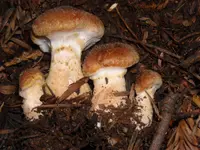
Armillaria sinapina is a wood-decaying fungus, not a typical houseplant, known for forming clusters of honey-colored mushrooms on dead or stressed trees. It produces underground rhizomorphs, often called shoestrings, that spread through soil and woody material.
This species occurs mainly in temperate forests of North America, especially on hardwoods like birch and aspen. It plays a role in breaking down wood but can also act as a weak pathogen on living trees.
Because it is a forest fungus with specific host and substrate needs, it is not easy to cultivate in regular garden or indoor settings. Those who want to grow or care for Armillaria sinapina usually work in specialized forestry or mycology contexts.

Care Difficulty
Moderate Care

Light Preference
Partial Shade

Water Requirements
Regular Water

Temperature Preference
Cold Hardy

Hardiness Zone
3–8

Soil Texture
Loamy, Silty, Organic-rich

Soil pH
Acidic (5.5–6.5), Slightly acidic (6.5–7.0)

Soil Drainage
Moist but well-drained

Fertilization
Minimal (feed rarely)
Scan your plant to receive care tips personalized for your specific plant
Available on iOS and Android
This wood-decaying fungus prefers cool, shaded woodland conditions rather than direct open sun.
Moist, cool substrates support this fungus better than dry, exposed conditions.
This species is adapted to temperate climates with cool to mild conditions through most of the year.
Humidity is not a primary factor for Armillaria sinapina, which naturally tolerates a wide outdoor range.
Armillaria sinapina develops best in consistently moist, aerated soil that supports wood decay.
This wood-decay fungus is not suitable for typical container growing.
This wood-decaying fungus is usually not fertilized, since it feeds directly from host wood and soil organic matter.
Pruning is not applied to Armillaria sinapina itself but to limit damage on infected woody hosts.
This species is not managed by repotting; attention focuses on handling infected trees or stumps during transplanting or removal.
Intentional propagation of Armillaria sinapina is rarely recommended outside research or diagnostic settings.
This fungus is cold hardy and typically requires no intentional winter care in landscapes.

Plant Health Check
Not sure what's wrong with your plant? Check your plant's health inside the app.
This fungus is most commonly found in boreal and cold-temperate forests of North America, especially in association with conifers such as spruce and fir, rather than the broad host range seen in some other Armillaria species.
Compared with aggressive relatives like Armillaria solidipes, this species is usually considered a less virulent root pathogen, more often colonizing already stressed or declining trees than killing vigorous hosts outright.
The fruiting bodies often show yellowish to mustard-colored tones on the cap and stem, a feature that originally inspired the epithet sinapina, derived from a Latin term relating to mustard.

Molecular studies have shown that Armillaria sinapina, once confused with other honey mushroom species based on appearance alone, can only be reliably separated using DNA-based methods such as ITS sequencing, which led to significant reclassification of North American Armillaria collections.
This fungus spreads very aggressively through both soil and infected wood. Rhizomorphs, the black cord-like structures, can move underground between stumps and roots, making containment difficult once established in a planting area.
Keep your plants happy and healthy with plant identification, disease detection, and easy care guidance.

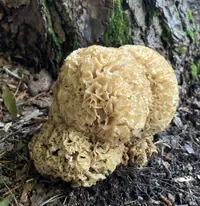
American cauliflower mushroom
Sparassis americana
Agrocybe acericola
Agrocybe acericola
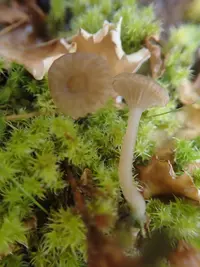
Arrhenia peltigerina
Arrhenia peltigerina
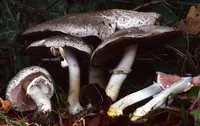
Inky Agaricus
Agaricus moelleri
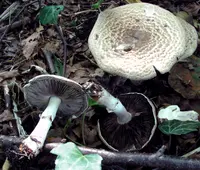
Tufted Wood Mushroom
Agaricus impudicus
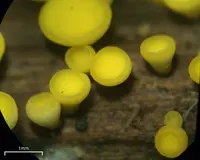
Yellow Fairy Cups
Bisporella citrina
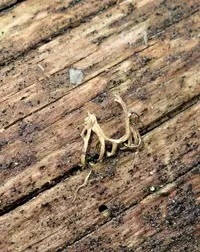
Artomyces cristatus
Artomyces cristatus
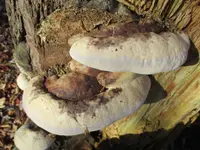
American Brown Fomitopsis
Fomitopsis ochracea