Use Wood Species
For reliable fruiting, inoculate fresh or recently cut hardwoods such as oak or beech, since this fungus colonizes dense wood more effectively than softwoods or fully decomposed logs.

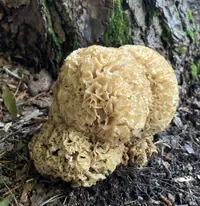
The American cauliflower mushroom, Sparassis americana, is a large, edible fungus that forms tight, frilly clusters resembling a pale, ruffled cauliflower. It grows on or near the base of conifer trees, usually appearing in late summer to fall in mixed and coniferous forests across parts of North America.
This species is saprobic, meaning it feeds on decaying wood, and it tends to return to the same spot for several years once established. In cultivation, it can be challenging because it needs suitable wood-based substrate, stable moisture, and protection from drying winds. Those who want to learn how to care for American cauliflower mushroom should know it prefers cool, shaded conditions and consistently moist, well-drained organic material.

Care Difficulty
Hard Care

Light Preference
Partial Shade

Water Requirements
Keep Soil Moist

Temperature Preference
Cool Climate

Hardiness Zone
Unknown

Soil Texture
Loamy, Organic-rich

Soil pH
Acidic (5.5–6.5)

Soil Drainage
Moist but well-drained

Fertilization
Minimal (feed rarely)
Scan your plant to receive care tips personalized for your specific plant
Available on iOS and Android
This woodland fungus prefers dappled, forest-like light conditions rather than open sun.
Moist, not waterlogged, conditions are essential for reliable fruiting of this fungus.
This species fruits best in cool to mild conditions typical of temperate forests.
This fungus needs consistently high humidity to fruit well and resist drying.
Sparassis americana relies on woody, organic-rich substrate rather than typical garden soil.
This species can be grown in containers if a deep, stable vessel supports its woody substrate and moisture needs.
This fungus relies mainly on its tree host for nutrition, so direct fertilization of Sparassis americana is usually unnecessary.
Pruning Sparassis americana is not a standard practice, as it is a wild, host-dependent fungus rather than a garden shrub or houseplant.
Transplanting this mycorrhizal fungus is rarely successful, as it depends on a stable association with living tree roots.
Propagation of Sparassis americana is specialized and not typically done by home growers, as it requires compatible tree hosts and careful environmental control.
This cold-hardy forest fungus needs no active winter care in typical outdoor conditions within its range.

Plant Health Check
Not sure what's wrong with your plant? Check your plant's health inside the app.
Sparassis americana was long confused with the European Sparassis crispa, but genetic and microscopic studies confirmed it as a separate North American species with its own distinctive features and distribution.
This fungus usually forms a dense, compact, cauliflower-like mass with relatively thicker and less frilly branches than S. crispa, which helps mycologists distinguish it in the field.
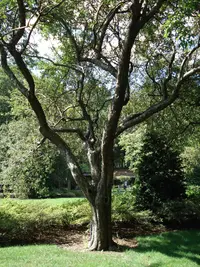
Sparassis americana typically grows at the base of living oaks and other hardwoods, acting as a parasite that slowly decays the host tree’s roots and butt, often appearing repeatedly at the same tree over several years.

Molecular phylogenetic analyses place Sparassis americana in a distinct North American clade within the Sparassis genus, meaning its evolutionary history is more closely tied to eastern North American hardwood forests than to the conifer-associated Sparassis species common in Europe and parts of Asia.
This species is considered a choice edible when young, firm, and clean. Always confirm identification with an expert, avoid old or decaying fruiting bodies, and cook thoroughly, as undercooked wild fungi may cause digestive discomfort.
Keep your plants happy and healthy with plant identification, disease detection, and easy care guidance.