Improve Winter Drainage
In cold, wet climates, create a low mound or raised strip of gritty soil 5–10 cm high for the crown so winter moisture drains away from the base and reduces rot risk.

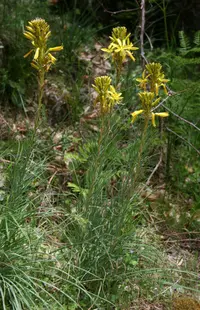
King's-spear (Asphodeline lutea) is a clump-forming perennial from the eastern Mediterranean, valued for its upright habit and late spring flowers. It produces narrow, blue-green, grass-like leaves and tall spikes of star-shaped yellow blooms that give strong vertical structure in sunny borders or gravel gardens.
In suitable conditions it forms slowly expanding clumps rather than spreading aggressively. It prefers full sun, well-drained, often lean or rocky soil, and tolerates dry conditions once established. These drought-tolerant traits usually make it straightforward for gardeners who want to learn how to care for King's-spear without high maintenance demands.

Care Difficulty
Easy Care

Light Preference
Full Sun

Water Requirements
Low Water

Temperature Preference
Cold Hardy

Hardiness Zone
5–8

Soil Texture
Sandy, Loamy, Rocky

Soil pH
Slightly acidic (6.5–7.0), Slightly alkaline (7.0–7.5)

Soil Drainage
Well-drained

Fertilization
Minimal (feed rarely)
Scan your plant to receive care tips personalized for your specific plant
Available on iOS and Android
This sun-loving Mediterranean perennial needs strong light to flower well.
This drought-tolerant perennial prefers infrequent, deep watering rather than frequent light applications.
This hardy perennial thrives in temperate climates with cool winters and warm, dry summers.
Asphodeline lutea does not have special humidity requirements and grows well in typical outdoor ambient air in temperate climates.
This species prefers lean, well-drained, often sandy soil that mimics its dry, rocky native habitats.
This species can be grown in containers outdoors if the pot is prepared to drain very sharply and stay relatively dry between waterings.
Asphodeline lutea is adapted to lean, well-drained soils and needs only modest feeding for good flowering.
Asphodeline lutea needs only light pruning to stay tidy and to support flowering performance.
This deep-rooted perennial is best grown in the ground; transplant only when necessary to limit root disturbance.
Asphodeline lutea is commonly propagated by seed or by careful division of established clumps.
This species is generally cold hardy in much of the US and usually needs minimal winter attention in the ground.

Plant Health Check
Not sure what's wrong with your plant? Check your plant's health inside the app.
This species is naturally found on dry, rocky slopes and calcareous grasslands from the Mediterranean to Western Asia, where it is adapted to shallow, lime-rich soils and seasonal summer drought.
Its tall, candle-like flower spikes open bright yellow, star-shaped flowers gradually from the base upward, and the blossoms release a stronger, sweet fragrance in the evening to attract nocturnal pollinators.
The plant forms fleshy, carrot-like roots that store water and nutrients, allowing it to survive poor soils and dry summers and to re-sprout reliably each year under suitable conditions.

In some regions of the eastern Mediterranean, young shoots and roots of this species have traditionally been foraged and eaten cooked as a wild vegetable, though such use is highly local and not widely documented in modern cuisine.
Lack of flowering usually comes from insufficient sun, overly rich or wet soil, or plants that are still immature. Ensure full sun, free-draining soil, and avoid high-nitrogen fertilizer. Division or transplant shock can also delay blooms for a season.
Keep your plants happy and healthy with plant identification, disease detection, and easy care guidance.