Mark clump edges
Use small stones or discreet pegs to mark the outer edge of each clump in late spring so you avoid slicing through dormant crowns when cultivating or weeding nearby in autumn and winter.

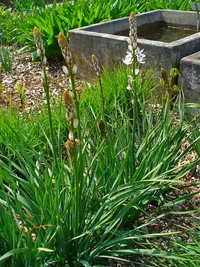
White asphodel (Asphodelus albus) is a perennial herbaceous plant known for its tall flower spikes and star-shaped white blooms with fine brownish veins. It forms clumps of narrow, grass-like leaves at the base, with flowering stems that rise well above the foliage.
This species is native to Mediterranean and southwestern European regions, where it grows in open meadows, rocky slopes, and light scrub. In gardens it suits naturalistic or meadow-style plantings and tends to be long-lived once established.
It prefers full sun, well-drained, often rocky or sandy soil, and relatively dry conditions in summer, which shapes how to care for White asphodel in typical garden settings.

Care Difficulty
Moderate Care

Light Preference
Full Sun

Water Requirements
Moderate Water

Temperature Preference
Cold Hardy

Hardiness Zone
5–8

Soil Texture
Sandy, Loamy, Rocky

Soil pH
Slightly acidic (6.5–7.0), Slightly alkaline (7.0–7.5)

Soil Drainage
Well-drained

Fertilization
Minimal (feed rarely)
Scan your plant to receive care tips personalized for your specific plant
Available on iOS and Android
This Mediterranean perennial thrives in open, bright conditions with strong, direct sun.
This drought-tolerant perennial prefers deep, infrequent watering rather than constant soil moisture.
This hardy perennial tolerates cool winters and warm summers when soil drainage is good.
Humidity is rarely limiting for Asphodelus albus and typical outdoor levels are usually adequate.
Asphodelus albus prefers lean, well‑drained, mineral soils that do not stay wet after rain or watering.
This species can be grown in containers if the pot is deep and drains quickly.
This perennial needs only modest feeding, as Asphodelus albus is adapted to nutrient-poor soils.
Pruning Asphodelus albus is minimal and focuses on cleanliness and sustained flowering.
This species is usually grown in the ground, so focus on careful planting and infrequent moving.
Propagation of Asphodelus albus is most practical by seed or careful division of mature clumps.
Mature plants are fairly cold hardy and usually need little winter attention in most temperate gardens.

Plant Health Check
Not sure what's wrong with your plant? Check your plant's health inside the app.
This species naturally occurs in montane grasslands and open scrub on basic, often limestone-rich soils across parts of the western and central Mediterranean, tolerating cold, snowy winters as well as dry summers once established.
It forms thick, carrot-like storage roots that act as perennating organs, allowing the plant to resprout each year after the aerial parts die back and helping it survive periodic drought and grazing.
The tall flowering stems carry many star-shaped white flowers with 6 tepals marked by a single brownish midvein, a feature that helps distinguish it from some related asphodel species with differently marked or colored flowers.

In traditional European folklore, especially influenced by ancient Greek and later literary references to asphodel meadows of the afterlife, this species and its close relatives became symbolically linked with death and remembrance, leading to its planting near rural cemeteries and memorial sites in parts of its native range.
Lack of flowering usually comes from plants being too young, insufficient winter chill, overcrowded clumps, or nutrient imbalance from high-nitrogen fertilizer. Division every few years and a low-nitrogen, high-potassium feed can support regular blooms.
Keep your plants happy and healthy with plant identification, disease detection, and easy care guidance.