Astilboides Care (Astilboides tabularis)

Astilboides

About Astilboides

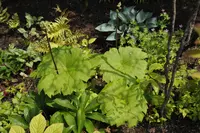
Astilboides, especially Astilboides tabularis, is a hardy, herbaceous perennial grown mainly for its dramatic foliage. It forms large, rounded, almost umbrella-like leaves on tall stalks, creating a bold, architectural look in shaded gardens.

This species is native to moist mountain habitats in East Asia, where it grows along streams and in cool woodland clearings. In cultivation it prefers consistently moist soil, protection from hot sun, and rich organic matter.

Its strong shade tolerance and fast leaf growth make it impressive but somewhat demanding in dry or exposed sites. Gardeners who learn how to care for Astilboides usually find it reliable in cool, evenly moist conditions.

Main Plant Requirements

Care Difficulty

Moderate Care

Light Preference

Partial Shade

Water Requirements

Keep Soil Moist

Temperature Preference

Cold Hardy

Hardiness Zone

4–7

Soil Texture

Loamy, Silty, Organic-rich

Soil pH

Acidic (5.5–6.5), Slightly acidic (6.5–7.0)

Soil Drainage

Moist but well-drained

Fertilization

Light (every 4–6 weeks)

Get Personalized Care Plan

Scan your plant to receive care tips personalized for your specific plant

Available on iOS and Android

How to Care for the Astilboides

This shade-loving perennial needs bright but gentle light to support large, healthy leaves.

  • Provide dappled or filtered light with 2–4 hours of early morning sun; avoid direct midday sun that can scorch the foliage.
  • Site the plant in partial to full shade, such as north or east sides of buildings, or beneath high tree canopies for consistent cover.
  • In very bright climates, increase shade in summer, while in cooler, cloudier regions Astilboides benefits from slightly more open, filtered exposure.

This moisture-loving plant thrives in consistently damp, never stagnant soil.

  • Aim for evenly moist soil, allowing only the top 1–2 cm to begin to dry before watering again, especially during active growth.
  • Use rich, humus-heavy soil that drains freely but holds moisture; avoid standing water, which leads to root rot and sour odors.
  • In hot, windy weather increase watering, watching for drooping leaves as a sign of thirst; yellowing, limp foliage often signals overwatering in Astilboides tabularis.

This hardy perennial prefers cool to mild conditions and dislikes extreme heat.

  • Support strongest growth at 60–75°F (16–24°C), typical of cool to mild summers in shaded garden positions.
  • Mature clumps tolerate winter lows near 0°F (−18°C) with mulch protection, as the plant survives as underground rhizomes.
  • In hot climates, protect from prolonged heat above 85°F (29°C) by deep shade and ample moisture, since high temperatures plus sun stress scorch leaves and reduce vigor.

This plant prefers consistently moist air but usually copes outdoors without special humidity control.

  • Aim for 50–70% humidity in sheltered, shaded sites, especially in warmer regions.
  • Leaves may brown at the edges or curl if exposed to hot, drying winds or very low humidity.
  • Increase local humidity by planting near water features, using dense companion planting, or providing a windbreak.

Astilboides tabularis needs deep, moisture-retentive but aerated soil to support its large leaves.

  • Use a rich loam with high organic matter, such as garden soil mixed with compost and leaf mold, to hold moisture evenly.
  • Ensure slow, steady drainage; avoid heavy, airless clay that stays waterlogged or very sandy soil that dries rapidly.
  • Aim for slightly acidic to neutral pH around 6.0–7.0, which supports nutrient availability and healthy root growth.
  • Improve structure and aeration by working in coarse compost, fine bark, or a small amount of grit, breaking up compaction before planting.

This species can be grown in large containers outdoors, but only if moisture and stability are carefully managed.

  • Choose a wide, heavy container to counterbalance the large leaf canopy and prevent tipping in wind.
  • Use an extra-deep potting volume to buffer moisture fluctuations and keep the root zone cool in summer heat.
  • Elevate the container slightly off the ground so drainage holes remain clear and excess water escapes freely.

This moisture-loving perennial benefits from modest, consistent nutrition during the growing season.

  • Apply a balanced slow-release fertilizer (around 10-10-10) in early spring as new Astilboides leaves emerge.
  • Supplement with a light top-dressing of compost once per year to improve soil structure and microbial activity.
  • During active growth, use a half-strength balanced liquid feed every 4–6 weeks if soil is low in organic matter.
  • Stop feeding in late summer; avoid fertilizing in fall and winter to prevent soft, frost-tender growth.

Pruning needs for Astilboides tabularis are minimal and focus on tidiness rather than shaping.

  • In late fall or early spring, cut back dead or collapsed leaves at the base using clean, sharp pruners.
  • Remove any damaged, yellowing, or pest-affected foliage during the growing season to limit disease spread.
  • Thin out congested leaves only where they smother neighboring plants, keeping the plant’s natural form.
  • Disinfect tools before and after use to reduce the risk of transmitting fungal or bacterial problems.

This large, clump-forming perennial is usually grown in the ground, with transplanting done infrequently.

  • Transplant Astilboides tabularis in early spring or early fall, when temperatures are mild and soil is moist.
  • Look for signs such as crowded crowns, reduced leaf size, or slow recovery after watering to decide on moving it.
  • Lift the clump with a wide root ball, disturbing roots as little as possible and replant at the same depth.
  • Water thoroughly after transplanting, then keep soil consistently moist and shade the plant for 7–10 days to reduce stress.

New plants are most reliably produced by division rather than seed for this species.

  • Divide established clumps in early spring as buds swell, when soil is workable but growth is just starting.
  • Lift the parent plant carefully and split the crown into sections, each with several buds and healthy roots.
  • Replant divisions immediately into rich, moist, shaded soil, firming well and watering deeply.
  • Seed propagation is possible but slow; sow fresh seed in cool, evenly moist conditions with light exposure.

This hardy perennial tolerates cold winters, but simple measures support long-term vigor.

  • Astilboides tabularis survives typical USDA 4–7 winters once established, with foliage naturally dying back after frost.
  • Leave or apply a 5–8 cm layer of mulch over the root zone to buffer freeze–thaw cycles.
  • In very exposed sites, add extra leaf mulch around crowns after the ground cools but before severe freezes.
  • Move container-grown plants into a sheltered, unheated area and keep soil just slightly moist, not waterlogged.

Care Tips

Summer shade netting

In hotter regions, use 30–40% shade cloth during midsummer to prevent leaf scorch and keep the soil cooler around the roots when growing Astilboides.

Moisture-retaining mulch

Apply a 5–8 cm layer of fine bark or leaf mold around the plant each spring, keeping it a few cm away from the crown to stabilize soil moisture and reduce weed competition.

Slug and snail barrier

Place rough copper tape or abrasive grit (such as crushed lava rock) in a ring around emerging shoots in early spring to reduce slug and snail damage to the tender new leaves.

Crown protection in winter

In cold climates, loosely pile dry leaves or straw over the crown after the first hard frost, then remove the covering gradually in early spring to protect new buds from freeze-thaw cycles.

Dividing for vigor

Every 4–6 years, lift and divide large clumps in early spring, replanting only firm, healthy rhizome sections with several buds to maintain plant vigor and control size in the planting area.

Common Pests and Diseases

Slugs and snails

This pest is strongly attracted to the large, tender leaves and can cause extensive shredding, especially in damp shade. Symptoms include irregular holes, tattered leaf edges, and slime trails on or around the plant.

Solution

Hand-pick slugs and snails in the evening, use beer traps or iron phosphate pellets around the clump, and remove hiding places such as dense debris or boards. Maintain slightly drier soil surface by watering in the morning rather than evening, and consider using copper tape barriers for container-grown plants as part of broader Astilboides care instructions.

Leaf spot (fungal)

This disease appears as brown or purplish spots that may merge into larger blotches, often starting on lower leaves in humid, still conditions. Symptoms include discolored patches with a yellow halo and premature leaf yellowing or collapse.

Solution

Remove and discard affected leaves promptly and avoid overhead watering to keep foliage as dry as possible. Improve spacing and airflow, water at soil level, and in severe or recurring cases apply a labeled ornamental fungicide during periods of prolonged humidity.

Powdery mildew

This disease shows up as a white to gray, powdery coating on the upper leaf surface, especially in warm days and cool, damp nights. Symptoms include dull, distorted foliage and reduced vigor later in the season.

Solution

Increase airflow by thinning surrounding vegetation, avoid crowding, and water at the base so leaves dry quickly. Remove heavily affected leaves and, if needed, use a sulfur or potassium bicarbonate fungicide labeled for ornamentals at the first signs of infection.

Aphids

These insects cluster on young stems and leaf undersides and suck plant sap, causing curling or distortion of new growth. Symptoms include sticky honeydew on leaves and nearby surfaces, sometimes followed by sooty mold growth.

Solution

Spray colonies off with a strong stream of water and prune out heavily infested shoots. For persistent populations, apply insecticidal soap or horticultural oil to leaf undersides and repeat as needed, monitoring new growth regularly.

Vine weevils

This pest affects shade-loving perennials by adult feeding on leaf margins and larvae feeding on roots and crowns. Symptoms include notched, scalloped leaf edges and, in heavier infestations, wilting or collapse despite adequate moisture due to root damage.

Solution

Inspect leaves at night for adults and hand-pick where possible, and avoid leaving dense, undisturbed mulch right at the crown. In containers or small beds, use beneficial nematodes targeting vine weevil larvae in spring or late summer and consider replacing heavily infested soil if decline continues.

Interesting Facts

Huge shield leaves

This species produces nearly circular, peltate leaves that can reach over 60 cm across, with the petiole attached near the leaf center rather than the edge, creating a distinctive shield-like form uncommon among hardy perennials in temperate gardens.

Moisture-loving giant

In its native habitats of northeastern China and Korea, it grows along cool, moist stream banks and damp woodland slopes, which explains its strong preference for consistently moist, humus-rich soils in cultivation.

Foamy midsummer plumes

Despite being grown mainly for foliage, it sends up airy, branched panicles of small, creamy-white flowers in early to midsummer, somewhat resembling but more open than those of true Astilbe, reflecting its past placement near that genus.

Botan icon

Did you know?

The species name tabularis refers to its table-like leaf surface, which is almost flat and can form a broad, horizontal platform that visually reads as a living tabletop in shaded garden compositions.

FAQs about Astilboides

Growth is moderate. In suitable conditions, clumps usually reach near-mature size in 3–5 years. Leaf size increases quickly once the root system is established, but ultimate spread and fullness continue to improve over several more seasons.

Grow Healthy Plants with Botan Care

Keep your plants happy and healthy with plant identification, disease detection, and easy care guidance.

Botan plant care app — identify plants on mobile

Explore More Plants