Early spine management
Install a rigid, tall barrier (such as wire mesh fixed to sturdy posts) around young plants so fronds and spines do not obstruct maintenance paths as the palm matures.

Astrocaryum aculeatissimum is a spiny, clumping palm native to coastal Atlantic forests of Brazil. It forms dense thickets with multiple stems covered in sharp spines.
The leaves are long, arching, and pinnate, giving the plant a strongly architectural look, but its heavy armature makes handling and placement challenging. It is sometimes grown for conservation or by palm enthusiasts rather than casual gardeners.
This species prefers warm, humid conditions, well-drained soil, and consistent moisture, similar to other tropical understory palms. Because of its slow growth, sensitivity to cold, and dangerous spines, it is considered a demanding species, so learning how to care for Astrocaryum aculeatissimum is important before planting it.

Care Difficulty
Hard Care

Light Preference
Full Sun

Water Requirements
Regular Water

Temperature Preference
Tropical / Frost Sensitive

Hardiness Zone
11–12

Soil Texture
Sandy, Loamy, Organic-rich

Soil pH
Acidic (5.5–6.5), Slightly acidic (6.5–7.0)

Soil Drainage
Moist but well-drained

Fertilization
Minimal (feed rarely)
Scan your plant to receive care tips personalized for your specific plant
Available on iOS and Android
This palm prefers bright, warm conditions that mimic open, humid tropical forest edges.
This species prefers evenly moist but fast-draining soil, with no prolonged standing water.
This palm is a warmth-loving species that does best in stable, frost-free climates.
This palm prefers moderately humid air but adapts if moisture levels are managed carefully.
Astrocaryum aculeatissimum needs sharply drained yet moisture-retentive soil that mimics a sandy, organic forest floor.
This species can be grown in containers when young, but the setup must prioritize root space and stability.
This palm grows in nutrient-poor soils and usually needs minimal feeding when planted in the ground.
This species needs very little pruning and is mainly cleaned rather than shaped.
Astrocaryum aculeatissimum is usually grown in the ground, but young plants may start in containers before transplanting.
This palm is almost always propagated from seed, which is slow and better suited to patient growers or nurseries than casual home propagation.
This tropical to subtropical palm is not frost hardy and needs specific winter protection in cooler climates.

Plant Health Check
Not sure what's wrong with your plant? Check your plant's health inside the app.
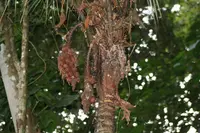
This palm develops a stout trunk armed with dense, rigid black spines that can exceed 10 cm, forming an effective mechanical defense against herbivores in the Atlantic Forest of Brazil.
It is native to the Brazilian Atlantic Forest, where it occurs mostly in restinga and lowland forest habitats on sandy or well-drained soils and contributes fruits to the diet of local wildlife.
The yellow to orange fruits have an oily, edible pulp traditionally used as a food resource in parts of coastal Brazil, but the heavy armament of the plant makes harvesting laborious and risky.

In some coastal regions of Brazil, the extremely hard, spiny leaf bases and trunk of this palm have been used as a natural barrier or living fence, taking advantage of the species’ dense armor to deter both humans and large animals.
This palm grows slowly, usually adding only 10–30 cm of trunk height per year once established. Seedlings and juveniles can remain small for many years, so planning long-term space and placement is important.
Keep your plants happy and healthy with plant identification, disease detection, and easy care guidance.