Spine-safe handling
Wear thick leather gloves and long sleeves whenever repotting or inspecting this species, and use tongs or a folded towel to steady the trunk to avoid injury from the sharp spines and to prevent trunk damage from rough gripping.

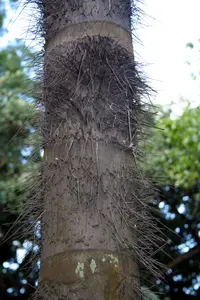
Black palm, Astrocaryum standleyanum, is a spiny, clustering palm native to humid tropical forests of Central and South America. It forms tall, slender stems with a narrow crown of arching fronds. The trunk and leaf bases are armed with very sharp black spines, which make handling and maintenance more demanding. In nature it grows in warm, consistently moist conditions with rich, well-drained soil and high air humidity. For anyone learning how to care for black palm, its main challenges are its large eventual size, high light needs, and sensitivity to cold or dry air.

Care Difficulty
Hard Care

Light Preference
Partial Shade

Water Requirements
Keep Soil Moist

Temperature Preference
Tropical / Frost Sensitive

Hardiness Zone
11–12

Soil Texture
Loamy, Silty, Organic-rich

Soil pH
Acidic (5.5–6.5), Slightly acidic (6.5–7.0)

Soil Drainage
Moist but well-drained

Fertilization
Minimal (feed rarely)
Scan your plant to receive care tips personalized for your specific plant
Available on iOS and Android
Astrocaryum standleyanum prefers bright, tropical-style light with some protection from intense midday sun.
Astrocaryum standleyanum prefers consistently moist but not waterlogged soil, similar to a humid forest floor.
This palm thrives in warm, frost-free conditions that resemble lowland tropical climates.
This palm prefers consistently humid air and reacts quickly to dry conditions.
Astrocaryum standleyanum needs deep, moisture-retentive but fast-draining soil that mimics rich tropical forest conditions.
This species can be grown in large containers when given enough root volume and stable support.
This tropical palm benefits from moderate, targeted feeding when grown in containers or managed landscapes.
Astrocaryum standleyanum needs minimal pruning and is usually maintained by removing old or damaged growth.
This spiny palm is slow to establish and should be transplanted infrequently and with care.
This palm is usually propagated from seed, but germination is slow and requires patience and warm conditions.
This strictly tropical palm lacks frost tolerance and requires thoughtful winter management in cooler climates.

Plant Health Check
Not sure what's wrong with your plant? Check your plant's health inside the app.
This palm develops a trunk densely covered with long, sharp black spines that can exceed several centimeters, providing strong protection against herbivores climbing to reach the crown and fruits.
Its large, oil-rich fruits are a key food source for agoutis, pacas, peccaries, and several primates in Central and South American forests, helping support complex seed-dispersal networks.
Indigenous communities use the tough, flexible leaf and stem fibers to make baskets, fishing nets, and other durable household items, reflecting long-standing cultural knowledge of the species’ material properties.

The seeds are often cached by agoutis, which bury them as food reserves; many forgotten seeds later germinate, so the animal’s hoarding behavior directly drives the natural regeneration and growing black palm populations in its native forests.
Growth is slow to moderate. Seedlings and young plants often add only 15–30 cm in trunk height per year in suitable tropical or subtropical climates, with faster vegetative expansion where warmth, moisture, and nutrients are consistently available.
Keep your plants happy and healthy with plant identification, disease detection, and easy care guidance.